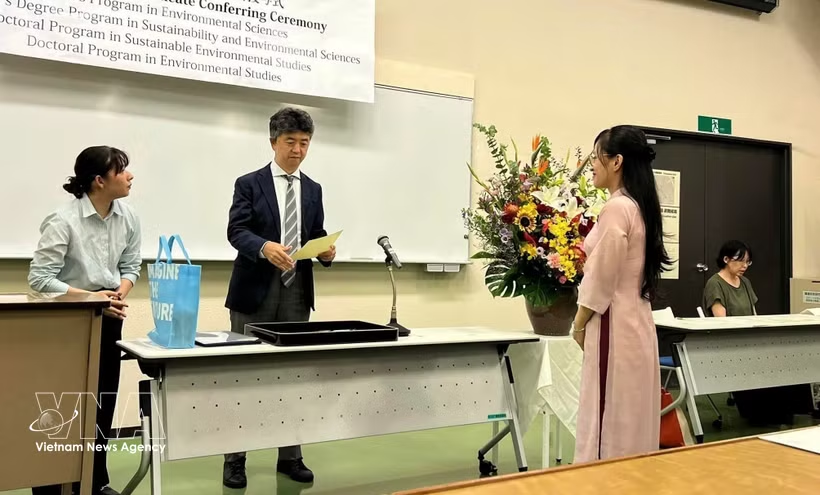
 A lecturer from the Hue University's University of Economics defends doctoral dissertation at the University of Tsukuba in Japan. (Photo: VNA)
The Hue University (HU) is advancing the internationalisation of its education system by recruiting talent globally and pushing faculty members to train at elite foreign establishments.
The drive underpins a sweeping overhaul of teaching and research, directly tying into the Politburo’s Resolution No. 71-NQ/TW, dated August 22, 2025, which targets breakthroughs in education and training.
Building an overseas study fast track
The HU’s University of Economics has capitalised on a young, multilingual, and globally adaptable faculty by prioritising overseas study placements for lecturers.
The university and its faculty have actively tapped government scholarships, international grants, and state budget funding to pursue master’s and doctoral courses abroad. Nearly 400 faculty members and staff have been sent for postgraduate studies at domestic and overseas establishments so far, lifting the share of lecturers holding doctorates to roughly 50%.
Assoc. Prof. Dr Truong Tan Quan, Rector of the University of Economics, said the university has adopted strategic academic planning matched with the needs of its disciplines, steering faculty toward developed countries with advanced education systems and strengths in business and management.
Target destinations include Northeast Asia and Western Europe for finance, international trade, logistics, management information systems, and data analytics, along with New Zealand, Belgium, and the Netherlands for business administration, accounting, economics, and agribusiness.
Quan added that beyond sending lecturers abroad, international cooperation has played a crucial role in personnel development, upgrading teaching quality, reshaping curricula, and improving overall training outcomes.
The University of Economics now partners with more than 40 universities and international bodies, runs four joint degree courses with foreign peers, and has launched major research projects alongside a pipeline of cooperation agreements, he said.
Scaling global partnerships
The HU now counts 3,687 staff members, including 1,900 lecturers, 861 doctorate holders, 17 specialist doctors, 18 professors, 240 associate professors, 225 senior lecturers, and 527 principal lecturers. Between 2020 and 2025, its doctorate cohort jumped nearly 20%, while the number of professors and associate professors climbed almost 5%.
The HU has forged ties with more than 400 universities, research institutes, educational and scientific organisations across over 30 countries in multiple fields.
Policies incentivising research and publication have built a robust academic environment that draws in both faculty members and students, driving a sharp rise in Web of Science and Scopus-indexed papers over the past five years.
In 2024, the university’s output in top-tier international journals surpassed 650 for the first time.
HU Vice President Dr. Bui Van Loi said the resolution of the university’s seventh Party Congress for 2025–2030 makes talent acquisition and retention, along with building a top-tier faculty, central to the push to transform the HU into a national university. That ambition rests on treating talent attraction and highly qualified personnel as a core and long-term mission.
In recent years, the HU has established a reward fund for outstanding achievements in professional development, training, and science – technology, and has launched competitive talent courses for young researchers and emerging scholars.
Moving forward, the HU plans to deepen ties with international universities across areas, scale up international joint training courses, and align with ASEAN and Asian competency frameworks. It will also facilitate access to global scientific and technological advances for faculty and students, thereby sharpening professional qualifications and capacity for global integration, he added.
VNA