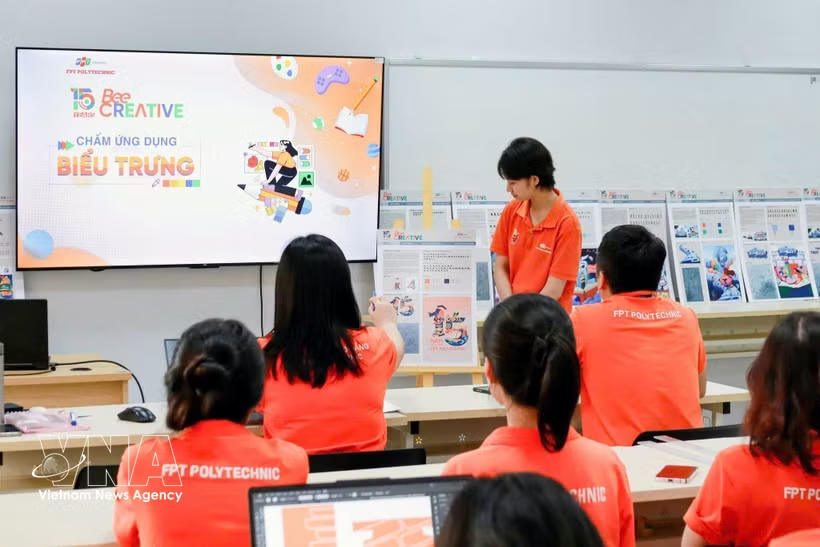
 Students engage in hands-on learning through the application of digital technology software. (Illustrative photo: VNA)
With strong political resolve, coordinated action across the political system and broad public support, the Politburo’s Resolution No. 57-NQ/TW on breakthroughs in science and technology development, innovation and national digital transformation has been implemented in a comprehensive and synchronised manner across sectors and localities, yielding concrete results in everyday life.
Students engage in hands-on learning through the application of digital technology software. (Illustrative photo: VNA)
With strong political resolve, coordinated action across the political system and broad public support, the Politburo’s Resolution No. 57-NQ/TW on breakthroughs in science and technology development, innovation and national digital transformation has been implemented in a comprehensive and synchronised manner across sectors and localities, yielding concrete results in everyday life.
The resolution has generated not only strategic momentum but also practical impact, as digital technologies are increasingly embedded in daily activities, driving socio-economic development and laying a solid foundation for rapid and sustainable growth in the new phase.
In education, digital transformation has shifted from a policy objective to an operational imperative. In Ho Chi Minh City, a digital school model built on advanced online management and learning platforms has enabled both teachers and students to access cutting-edge technologies. Beginning in the 2025–2026 academic year, the city has piloted artificial intelligence (AI) education in more than 170 high-quality schools, as well as digital schools, with flexible implementation tailored to institutional conditions. Schools outside the pilot programme have also been encouraged to integrate AI-related content into curricula and extracurricular activities.
The municipal education sector has accelerated digital governance, including the rollout of digital academic records with a view to fully digitising high school records during the 2025–2026 academic year. A shared digital learning ecosystem has been developed with standardised resources and internationally aligned connectivity platforms, while learning management systems have been widely deployed to support self-learning and assessment in digital environments.
Similar efforts have been observed in Ho Chi Minh City’s neighbouring Dong Nai province, where schools are gradually modernising teaching methods and fostering innovative learning environments. Le Quy Don Secondary School in Long Khanh ward was highlighted as an early adopter of the digital classroom model, where each student is equipped with a personal computer and lessons are delivered through interactive digital content, visual materials and video-based instruction. Such approaches have expanded access to knowledge and enabled students to learn anytime and anywhere through digital resource libraries and online question banks.
Meanwhile, the digital environment allows teachers to shift from knowledge transmitters to designers of learning experiences, with technology serving as a facilitative tool. However, the decisive pedagogical role remains with teachers, and expanding their professional autonomy in digital environments has been identified as a key condition for achieving digital transformation goals in education.
Beyond education, digital technologies are increasingly enhancing public service delivery. In Thanh Hoa province, a pilot model of smart kiosks has reportedly transformed administrative procedures, making them faster, more transparent and more user-friendly. Citizens can scan original documents at the kiosks, where the system automatically verifies and authenticates information before transferring it for processing. Within minutes, legally valid electronic copies can be issued, eliminating the need for prolonged waiting times.
The kiosks also integrate multiple public service functions, including application tracking, online payments and submission of essential administrative procedures. The system is connected to the national public service portal and the Ministry of Public Security’s service ecosystem, enabling convenient access to services such as criminal record certificates, driver’s license issuance and civil registration procedures.
Following positive pilot outcomes, Thanh Hoa plans to expand the model across all 166 communes and wards, with a focus on improving digital infrastructure and access, particularly in rural and mountainous areas.
Meanwhile, Ho Chi Minh City has deployed an AI-integrated camera surveillance system to enhance traffic management. Operating around-the-clock, the system can automatically detect and record a wide range of violations, including those previously difficult to address through manual methods. Since early 2026, nearly 2,000 cameras have identified approximately 122,500 traffic violations.
Further investment and expansion of AI-based monitoring systems are planned, contributing not only to improved governance but also to the development of smart, modern urban environments in line with the objectives of Resolution 57.
VNA