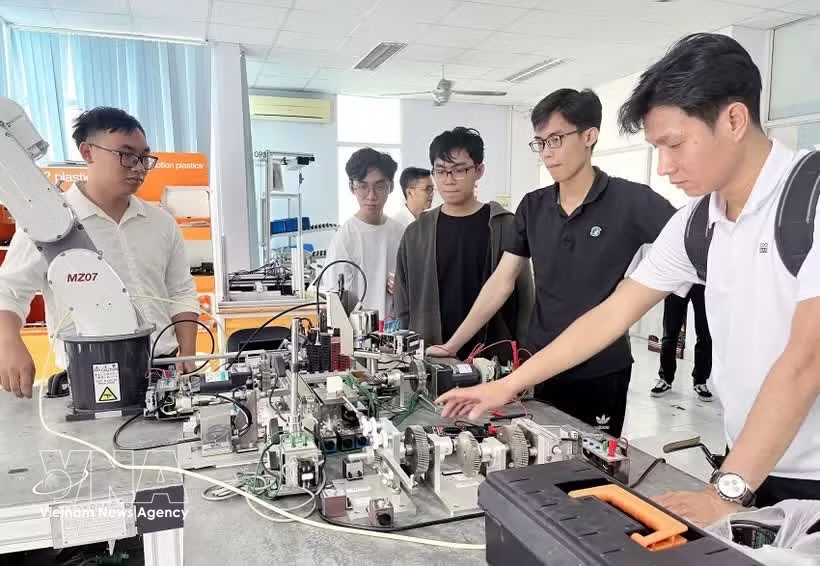
Illustrative image (Source: VNA)
Entering a new phase of development, Ho Chi Minh City is accelerating its transition toward a growth model driven by science and technology, innovation, and high-quality human resources.
Strategic investment in research and development (R&D), core technologies and innovation institutions is being positioned as a central pillar for building new competitive advantages.
Strong push for science and technology
The city is formulating a comprehensive programme for scientific research, technology development and capacity enhancement for the 2026–2030 period. By 2030, total social investment in R&D is targeted at 2–3% of GRDP, with over 60% sourced from the private sector. Each year, at least 40 municipal-level scientific projects are expected to be completed, alongside the launch of no fewer than 50 new research initiatives.
Authorities also aim to raise the rate of applied research outcomes to over 60% within 12 months of completion, while increasing the proportion of enterprises utilising research outputs from universities and institutes to at least 25%. Total factor productivity (TFP) is projected to contribute 60% to GRDP growth, and at least five internationally benchmarked research and innovation centres are to be established in key sectors.
To achieve these goals, the city is prioritising interdisciplinary flagship research programmes, focusing on strategic technologies, core platforms and high-value products. Digital transformation and smart city development remain at the forefront, including shared digital infrastructure, data-driven governance, cybersecurity solutions and digital products.
In industrial technology and smart manufacturing, emphasis is placed on semiconductor design, packaging and testing, AI and IoT chips, industrial and autonomous robotics, smart logistics, advanced processing technologies, new energy solutions, advanced materials, and digital manufacturing platforms. These efforts aim to enhance technological self-reliance, increase localisation rates and deepen integration into global value chains.
In healthcare, the city is promoting advanced biomedical and pharmaceutical technologies, digital health systems, precision and personalised medicine, genomics, smart medical devices, and AI in diagnostics and medical data analytics. These initiatives are expected to strengthen the healthcare system through improved prevention, early detection and effective treatment.
Urban agriculture is also being modernised through the application of advanced technologies tailored to urban conditions, contributing to higher productivity, improved quality and sustainable development. Meanwhile, programmes on modern urban operations and climate adaptation focus on flood control, tidal management, waste treatment, environmental monitoring, energy management, green transport, urban logistics and digital twin models for real-time simulation and decision-making. These are particularly critical for a megacity facing mounting infrastructure and environmental pressures.
Experts underscore that technological solutions must be complemented by appropriate institutions, inclusive governance, enhanced policy implementation capacity, transparency and citizen-centred approaches.
Advancing State-university-enterprise partnership
A key determinant of success lies in effective coordination among the State, educational institutions and enterprises. Cooperation between the municipal People’s Committee and the Vietnam National University – Ho Chi Minh City for the 2022–2025 period has delivered tangible outcomes, addressing challenges in infrastructure development, human resources training and institutional reform.
Building on this foundation, both sides have signed a new cooperation programme for 2026–2030. The city has commissioned the university to train high-quality personnel and talent in strategic sectors such as semiconductors, AI, IoT, blockchain, basic sciences, urban railways and financial services for the international financial centre.
The university will lead research on core technologies for the digital economy and participate in developing technology testing zones to support the startup ecosystem. Both sides also agreed to develop the university’s urban area into a smart model and establish a high-performance computing centre to underpin research and training.
To further integrate into the global semiconductor value chain, the city is promoting collaboration across electronics, microelectronics and semiconductor industries. While progress has been made, challenges remain in policy frameworks, intellectual property, financing and human resources quality, requiring coordinated solutions.
With a solid foundation, ongoing institutional reforms and strong investment in science and technology capacity, Ho Chi Minh City is steadily advancing toward its goal of becoming a leading regional hub for science, technology and innovation.
VNA