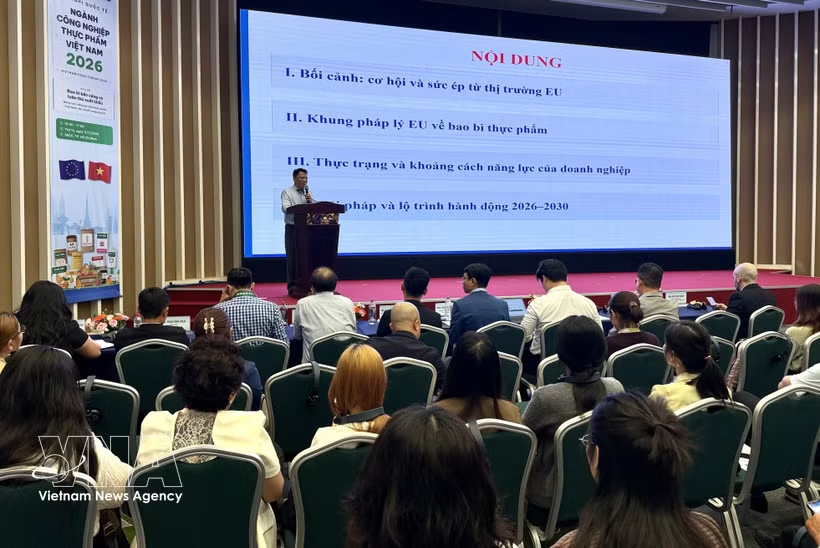
 At the 2026 Vietnam Food Forum (Photo: VNA)
As Vietnamese food exporters have rich raw material sources, better processing and deeper global supply chain roles, the prize is a bigger EU share, higher value and a stronger global position.
The EU is a top potential market for Vietnamese food, heard the 2026 Vietnam Food Forum in Ho Chi Minh City on November 11, held by the Vietnam Trade Promotion Agency and partners.
The EU–Vietnam Free Trade Agreement (EVFTA) tariff cuts are opening doors. But the EU is also a market with a strict and frequently updated system of standards and regulations, especially in food safety, quarantine, traceability, environmental protection and sustainable development, experts said.
Compliance now runs from product quality through production, processing, packaging, transport and distribution, they said, adding that the EU’s Packaging and Packaging Waste Regulation (PPWR) is adding a new layer of requirements for food exporters.
Nguyen Nam Phuong from Tetra Pak Vietnam said PPWR aims to cut packaging waste and make all EU packaging recyclable or reusable by 2030. From July 2026, the EU also bans Bisphenol A (BPA) in food contact packaging and materials.
Packaging is no longer just containment and branding. It has become a market-access gatekeeper for EU supply chains. Vietnamese firms must track rules, audit production and pick compliant packaging, with more focus on recyclability, waste cuts, eco-materials and food-contact safety, Phuong noted.
Gustavo Ferro, an expert from the Swiss Import Promotion Programme (SIPPO), flagged the EU trends Vietnamese suppliers must watch: food safety, private label, health food and sustainability, including packaging. In sustainable supply chain rules, sustainability carries value equal to the user.
He said current and upcoming EU sustainability rules for SMEs force changes in sourcing, business models, product formulas and production systems. Suppliers need extra work to meet buyers’ standards and certifications and complete documentation.
Le Hoang Tai, Deputy Director General of the Vietnam Trade Promotion Agency, said food-sector competitiveness will no longer hinge only on cost or quality. Meeting each market’s standards, rules and sustainability demands will matter just as much. It’s both a challenge and a driving force for production upgrades, technology investment, product improvement and management capacity enhancement.
The EU remains an attractive agri-food export market, and Vietnam’s export mix fits EU segments. Qualified outside suppliers still have room, but access depends on sanitary and phytosanitary (SPS) compliance and credible documentation, he added.
VNA