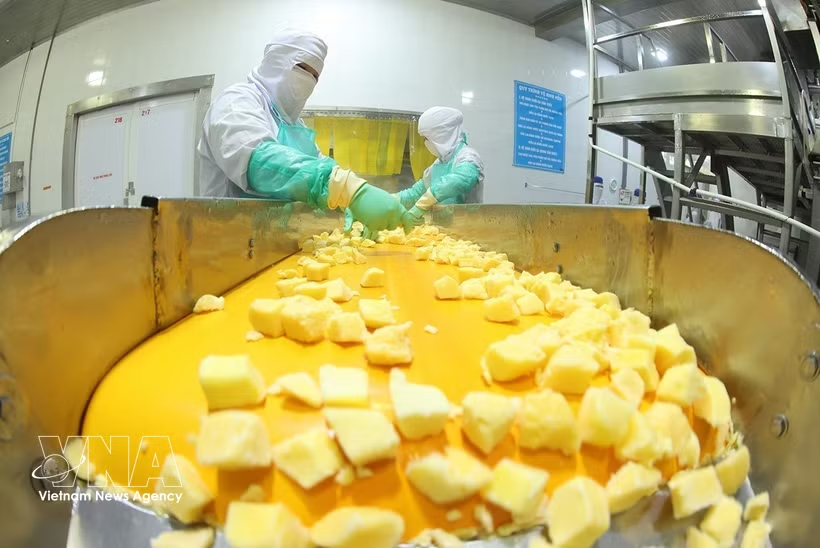
 Processing frozen mangos for export in An Giang province (Photo: VNA)
Advances in varieties, farming techniques and post-harvest technology are helping Vietnam’s fruit and vegetable sector overcome production bottlenecks, improve quality and reach higher-value market segments.
Technology powers growth
Customs data show that fruit and vegetable exports topped 8.27 billion USD in the first 10 months of 2026, up 17.2% from a year earlier, with growth holding across major markets. In the first nine months, China remained the largest buyer at 4.72 billion USD, up 22.4%. The US followed at 484.7 million USD, up 19.2%; the Republic of Korea (RoK) 263.6 million USD, up 11.1%; and Japan 193.8 million USD, up 6.2%.
The Netherlands, Australia, Malaysia, Germany, Russia and Canada also posted double-digit growth, signaling that Vietnamese fruits and vegetables are expanding in traditional markets while gaining a foothold in others.
In southern Tay Ninh province, local companies have adopted tissue culture, drip irrigation and modern harvesting systems, gradually forming banana farming zones that meet international standards for export to Japan, the RoK and other markets.
Building raw material zones to lift value chains
Pham Quoc Liem, General Director of U&I Agricultural JSC (Unifarm), said Vietnam has about 163,000 ha of bananas but export turnover only neared 420 million USD in 2025. If 24,000 ha of growing areas, about 15% of the current total, are standardised and exportable commercial yield are raised to 60 tonnes per ha, the banana sector could earn 1 billion USD from exports a year. If standardised area rises to 30%, export value could exceed 2 billion USD annually.
Liem said Vietnam needs chain-linked models for each key product, with clear roles for lead enterprises and clear responsibilities and benefits for stakeholders. The State should issue coordination policies and preferential credit support to build standardised raw material zones with stable productivity and quality. Research, development and commercialisation of competitive varieties will add further momentum.
Changes in production and trade show that science - technology is gradually changing how Vietnam’s fruit and vegetable sector creates value, toward the 10 billion USD export target for 2026 and higher milestones ahead.
VNA