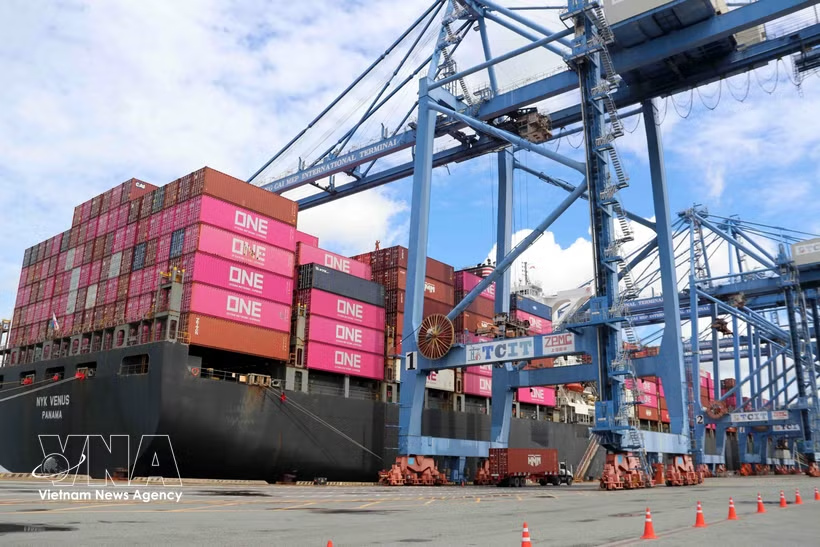
Tan Cang - Cai Mep International Port in Ho Chi Minh City is stepping up digital and green transformation to enhance its competitiveness in the global port network. (Photo: VNA)
An article entitled “Indonesia’s Factories Lag as Vietnam Races Ahead”, recently published by the Jakarta Globe, has noted that Indonesia’s manufacturing sector is struggling to compete with Vietnam, which boasts faster economic growth, a more stable investment environment and an increasingly developed industrial base, thereby attracting global manufacturers.
The article noted that Indonesia’s economy grew 5.47% year-on-year in the third quarter of 2026, its highest Q3 growth since 2023. Vietnam, meanwhile, recorded growth of 9.95%, despite having a nominal GDP nearly three times smaller. Vietnam’s industrial and construction sector expanded 11.2% in the first nine months while industrial production rose 12.3%.
The newspaper said that Vietnam’s GDP per capita is expected to increase 8.9% to 5,259 USD in 2026, surpassing Indonesia’s projected 5,153 USD. This would place Vietnam fifth in ASEAN, after Singapore, Brunei, Malaysia and Thailand.
Bob Azam, chairman of employment and manpower division at the Indonesian Employers Association (Apindo), attributed the shift partly to differences in economic growth and exchange rate movements. The Indonesian rupiah has depreciated by around 8% while the Vietnamese dong has appreciated 1.9%.
He stressed that Indonesia needs to improve not only growth rates but also growth quality by developing integrated supply chains, modernising agriculture and promoting both high-tech industries and export-oriented manufacturing. Removing investment barriers, particularly in licensing procedures, land costs and workforce skills, is also essential.
Mohammad Faisal, executive director of CORE Indonesia, said Vietnam’s appeal goes beyond relatively low labour costs, citing consistent policies, clear regulations and long-term investment incentives. Investors, he noted, prioritise stability and predictability in the business environment.
The writing traced Vietnam’s economic transformation to the Doi Moi (Renewal) process launched in 1986, which gradually opened the economy to international trade and foreign investment. Realised foreign direct investment reached 27.62 billion USD in 2025, up 9% year-on-year and the highest in five years.
Vietnam has also benefited from global manufacturers diversifying production away from China amid US trade tensions, attracting major companies such as Samsung and Foxconn. Its industrial structure is gradually shifting towards higher-value electronics and technology manufacturing.
The country’s export performance further demonstrates this progress. In 2025, Vietnam’s merchandise exports exceeded 475 billion USD, significantly higher than Indonesia’s approximately 282.5 billion USD.
Yusuf Rendy Manilet, a researcher at CORE Indonesia, said Indonesia would find it difficult to achieve Vietnam’s position in the short term but could establish itself as a manufacturing and distribution hub for ASEAN by reducing inter-island transport costs and ensuring more consistent industrial policies.
Meanwhile, Nailul Huda, director of digital economy at the Centre of Economic and Law Studies (CELIOS), described Indonesia as a “high-cost economy”, citing taxes, import barriers and expensive raw materials. He also pointed to its investment efficiency, with an incremental capital-output ratio (ICOR) of 6.4, compared with around 4.2 in Vietnam.
The Jakarta Globe, also highlighted difficulties surrounding Chinese automaker BYD’s 887-million-USD electric vehicle factory project in West Java, which is facing pressure from local groups demanding more employment opportunities for residents.
Despite these challenges, Indonesia’s manufacturing sector has shown signs of recovery. Its manufacturing Purchasing Managers’ Index (PMI) rose to 54 points in October 2026 from 52.4 in September, marking its strongest expansion since March 2024.
VNA