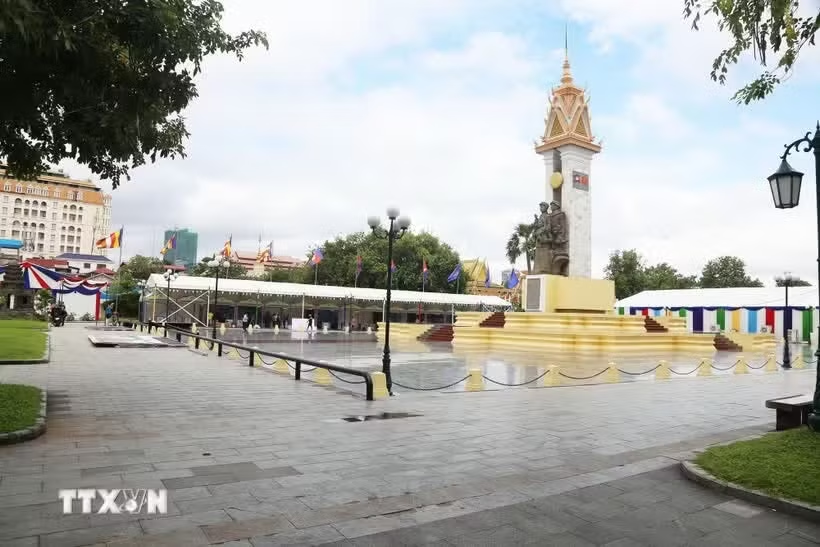
 Part of the Francophone Village next to the Vietnam–Cambodia Friendship Monument in Phnom Penh (Illustrative photo: VNA)
The 20th Francophonie Summit, hosted by Cambodia in Phnom Penh on November 15–16, provides an opportunity for Cambodia and Vietnam to build on their historical and cultural connections, expand people-to-people exchanges, strengthen educational and vocational cooperation, and deepen engagement between Southeast Asia and the Francophone world.
The assessment was made by Uch Leang, Acting Director of the Department of Asian–African and Middle Eastern Studies at the International Relations Institute of Cambodia, the Royal Academy of Cambodia (RAC), in an article published on Khmer Times on November 13.
Uch Leang, who is also President of the Cambodia Alumni from Vietnam Association, wrote that Cambodia and Vietnam occupy a distinctive position within the International Organisation of La Francophonie (OIF), reflecting their historical connections with the French language and Francophone culture. Today, both countries contribute to the Francophone community’s presence in Southeast Asia and provide important links between the region and the wider Francophone world.
At the summit, To Lam, General Secretary of the Central Committee of the Communist Party of Vietnam and President of Vietnam, is expected to lead a high-level Vietnamese delegation. The visit underscores the importance Vietnam attaches to its relations with neighbouring Cambodia and reaffirms its commitment to the Francophonie as a platform for promoting dialogue, mutual understanding, and collective responses to shared challenges in an evolving international environment.
Cambodia became a full member of the OIF at the 5th Francophonie Summit, held in Grand-Baie, Mauritius, in October 1993, following its participation as an observer at the 4th Summit in Paris in November 1991. This accession marked an important milestone in Cambodia’s international integration, opening new avenues for multilateral engagement and the diversification of its foreign relations. Through its participation in the Francophonie, Cambodia has progressively strengthened its international partnerships and expanded cooperation in education, science, culture, and human resource development, while seeking to advance its broader socio-economic development objectives.
More than three decades after joining the Francophonie, Cambodia’s hosting of the 20th Francophonie Summit offers a platform to translate its longstanding engagement with the Francophone community into tangible outcomes in education, skills development, cultural exchange, and sustainable development, the expert said.
Meanwhile, Vietnam joined the Agency for Cultural and Technical Cooperation (ACCT), the predecessor of the OIF, in 1979. The 7th Francophonie Summit, held in Hanoi in 1997, marked a historic milestone as it was the first to take place in Asia. The meeting advanced institutional development within the Francophonie and placed greater emphasis on economic cooperation and socio-economic development, alongside its established priorities of culture, political dialogue, and peace.
Uch Leang noted that Cambodia–Vietnam relations are grounded in the principles of “Good Neighbourliness, Traditional Friendship, Comprehensive Cooperation and Long-lasting Sustainability”. Building on this foundation, the two countries have opportunities to expand their engagement through multilateral frameworks, including the OIF. Such cooperation could help connect their longstanding bilateral relationship with broader regional and international development initiatives.
He perceived that three areas offer particular potential for translating this diplomatic momentum into tangible outcomes.
The first is strengthening coordination within the Francophonie and other multilateral frameworks. Cambodia and Vietnam could work more closely with other Francophone countries in Asia to promote shared interests and develop practical initiatives in trade, investment, food security, digital transformation, climate change adaptation and human resource development. Such coordination could complement their existing cooperation within ASEAN and Mekong subregional mechanisms.
The second is developing trilateral cooperation with Francophone partners. By connecting Vietnamese and Cambodian institutions and businesses with partners across the Francophone community, the two countries could explore joint projects in agricultural modernisation, food processing, education, healthcare, technology and green development. Partnerships of this kind could mobilise complementary expertise, broaden access to international markets and create additional opportunities for capacity-building.
The third is exploring Cambodia–Vietnam–Francophone value chains. Cambodia’s agricultural resources, Vietnam’s processing and manufacturing capabilities, and the logistics and market networks available through Francophone partners could provide a foundation for cross-border production partnerships. Joint initiatives could focus on processing agricultural products, improving storage and transport infrastructure, meeting export standards and accessing markets in Europe, North America and Africa. Their feasibility would depend on commercial demand, investment conditions, regulatory requirements and the competitiveness of the resulting products.
These opportunities acquire additional significance as Cambodia and Vietnam prepare to commemorate the 60th anniversary of their diplomatic relations in 2027. Linking this anniversary with cooperation through the Francophonie could help broaden the relationship beyond bilateral exchanges towards more coordinated engagement in multilateral institutions. It would also provide an opportunity to strengthen educational partnerships, youth exchanges, research collaboration and business networks, ensuring that the relationship delivers benefits that can be experienced by future generations.
The writing concluded that the value of Francophone cooperation will depend not only on diplomatic commitments but also on the ability of both countries to turn shared aspirations into practical initiatives. By aligning their historical ties with contemporary development priorities, Cambodia and Vietnam can use the Francophonie as an additional channel for strengthening bilateral relations, expanding international partnerships and contributing to peace, stability and sustainable development in Southeast Asia and beyond.
VNA