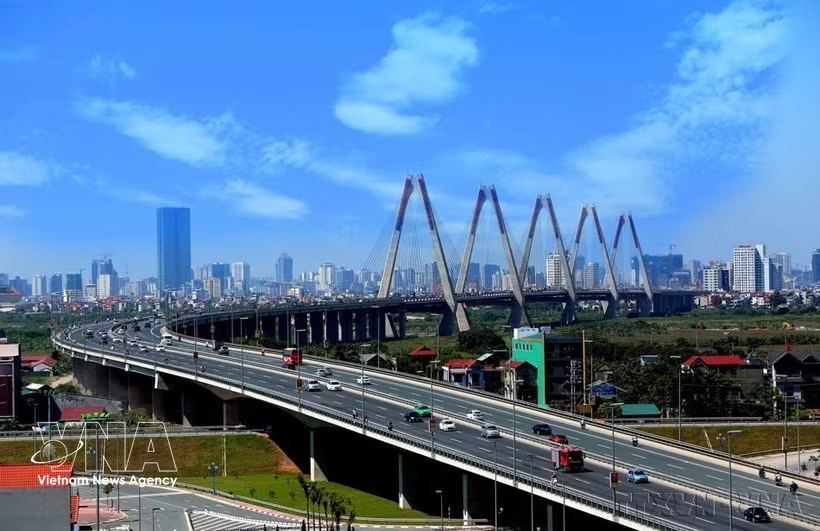
 Nhat Tan Bridge in Hanoi (Photo: VNA)
Hanoi must pursue faster growth while improving governance, the quality of people’s life and its contribution to national development in the new era, Politburo member and Secretary of the municipal Party Committee Tran Duc Thang noted in an article marking the 72nd anniversary of Capital Liberation Day (October 10, 1954–2026).
In the writing, Thang, who is also head of the National Assembly deputies’ delegation of Hanoi, reviewed the capital’s achievements, outlined its long-term development vision and identified key tasks for the years ahead.
He said that the 72nd anniversary of Capital Liberation Day is an occasion to honour generations who sacrificed for national independence and freedom and contributed to Hanoi’s liberation, construction and defence. It also serves as a reminder of the present generation’s responsibility for the capital’s and the country’s future.
In the new era, Hanoi must continuously strengthen its development capacity, carry forward the spirit of Liberation Day, improve people’s living standards and make greater contributions to national development. Achieving these goals requires a long-term vision, well-informed decisions and resolute action from the outset, he emphasised.
The value of Liberation Day and responsibility of today’s generation
Throughout Vietnam’s history, Thang Long – Hanoi has always played a particularly important role in major national milestones. The success of the August Revolution in Hanoi in 1945 inspired people nationwide to rise up and seize power. On September 2, 1945, President Ho Chi Minh read the Declaration of Independence at Ba Dinh Square, giving birth to the Democratic Republic of Vietnam, now the Socialist Republic of Vietnam.
After its liberation on October 10, 1954 that came as a result of the “globe-shaking” Dien Bien Phu Victory, Hanoi, together with northern Vietnam, embarked on building a peaceful life and advancing towards socialism while serving as a firm rear base for the struggle to liberate the South and reunify the country.
Over the past 72 years, Hanoi has joined the entire country in overcoming the devastation of war, rebuilding the economy, pursuing Doi Moi (renewal) and deepening international integration. From a city focused on restoring essential production and services after liberation, it has developed into the national political – administrative centre and a major hub for economic, cultural, scientific, technological and educational activities, as well as international integration. Its urban area has expanded, infrastructure been modernised, and living standards improved continuously.
Over successive stages of development, Hanoi has consolidated its identity as a capital of millennium-long culture, a heroic capital, a city for peace, a creative city and a UNESCO global learning city. It is also strengthening its role as a driver of regional development and national progress.
These achievements have provided a solid stepping stone for a new phase of development, Thang said, highlighting the municipal political system’s sweeping reforms of its leadership and implementation methods.
In addition, Hanoi is exerting efforts to establish itself as a pioneer in innovative mindset, decisive action and breakthroughs, ready to implement new policies and perform difficult, unprecedented tasks. At the same time, it is advancing the implementation of the two-tier local administration model, administrative reform and digital transformation. The city has topped the Provincial Innovation Index (PII) rankings for four consecutive years.
Sharing Hanoi’s impressive economic attainments, the official noted that in 2025, the local economy was valued at approximately 63.5 billion USD, ranking second nationwide. As much as 711 trillion VND was collected for the state budget, accounting for more than a quarter of the national total, while per capita GRDP approximated 180 million VND annually.
In 2026, the city has invested efforts in reaching its socio-economic development targets in line with directives from central authorities. GRDP grew 8.85% in the first nine months, including 10.02% in the third quarter.
By September 30, Hanoi had collected an estimated 567.6 trillion VND in state budget revenue, equivalent to 87.2% of the annual target and up 5.8% year on year. Foreign direct investment (FDI) reached 4.067 billion USD.
Alongside economic development, Hanoi has continued to invest in culture, healthcare, education and social security, firmly maintain national defence and security, and strengthen its international standing.
However, Thang admitted that Hanoi continues to face challenges and shortcomings. Economic growth remains below the set targets while several sectors have yet to achieve breakthroughs commensurate with their potential. Consumption, exports, services, tourism, real estate, science and technology all offer substantial scope for further development but remain untapped.
Given this, the Secretary underlined the need for the entire political system to show stronger resolve and intensify reforms to quickly capitalise on advantages and unlock resources for Hanoi’s development.
A 100-year vision for the capital’s future
The 72nd anniversary of Capital Liberation Day marks a significant milestone in Hanoi’s development. The Political Bureau’s Resolution No. 02-NQ/TW, issued on March 17, 2026, sets out orientations for developing the capital in the new era. The 2026 Capital Law provides the legal basis for special mechanisms, policies, and powers, while Hanoi’s master plan with a 100-year vision establishes a long-term framework for shaping its development.
Together, these measures provide a coordinated foundation for building a multi-polar and multi-centred capital, paving the way for major breakthroughs and double-digit growth in the coming years.
The 100-year vision calls for decisions that look beyond immediate needs and take account of their long-term impacts, the official went on, adding that the achievements gained so far and the major directions being implemented are shaping Hanoi’s development in both the immediate and long terms, opening up new prospects for the capital of time-honoured culture and heroism.
New opportunities are opening up as Hanoi and Vietnam at large enter a new era of development. Seventy-two years since its liberation, the city now bears a historic responsibility to continue fulfilling President Ho Chi Minh’s vision of a socialist capital.
Thang stated that the local Party organisation, administration and people will pursue coordinated measures and solutions to ensure the capital’s development keeps pace with the demands of the new era.
The 72nd anniversary of Capital Liberation Day, he said, reaffirms the value of independence and peace, as well as the trust that previous generations placed in their successors. Repaying that trust is both an honour and a responsibility for the capital’s Party organisation, administration, Party members and officials.
Drawing pride from its heroic history, Hanoi is confidently pursuing its 100-year vision, striving to become a civilised, modern and happy capital of time-honoured culture worthy of its role as the heart of the nation, according to the Secretary.
VNA