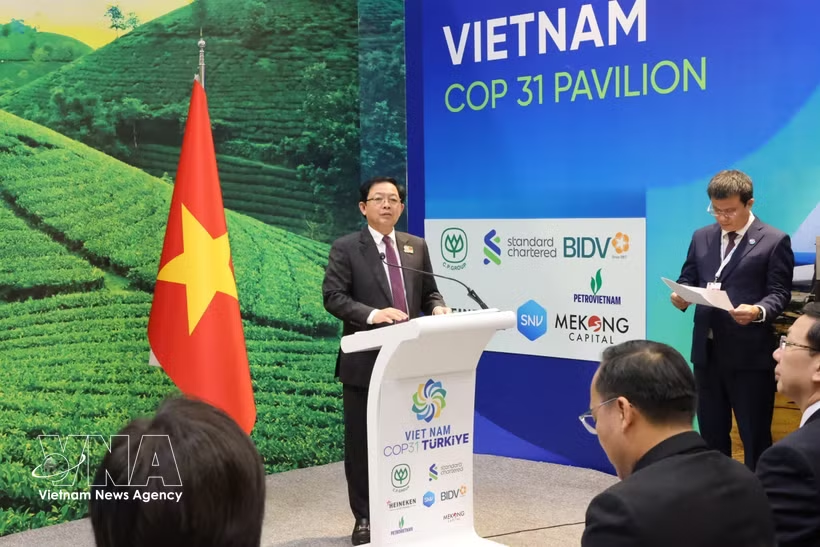
 Deputy Prime Minister Ho Quoc Dung speaks at the launch of the Partnership for Climate-Responsible Agricultural, Forestry and Fisheries Value Chain Transformation (P-CRAFT) on November 17. (Photo: VNA)
Deputy Prime Minister Ho Quoc Dung led a Vietnamese delegation to the high-level segment of the 31st Conference of the Parties to the United Nations Framework Convention on Climate Change (COP31), held in Antalya, Türkiye, on November 17-18.
Deputy PM Dung was the second speaker to address the COP31 high-level segment on November 17. He stressed that a significant gap remained between climate commitments and action, while developing countries continued to face difficulties in accessing finance and technology.
With the principle that “commitments must be honoured and actions must deliver results”, Vietnam is proactively mobilising domestic resources for climate change adaptation, energy transition and low-emission agricultural development, including the project to develop one million hectares of high-quality, low-emission rice cultivation in the Mekong Delta.
Based on the principle of common but differentiated responsibilities, the Deputy PM put forward three proposals.
First, developed countries and international financial institutions should take the lead in mobilising climate finance with the international community, with a view to raising 1.3 trillion USD annually by 2035, prioritising grants and concessional loans, particularly for adaptation efforts in developing countries.
Second, favourable conditions should be created for technology transfer, striking a balance between intellectual property protection and access to green technologies.
Third, the transition must be fair, inclusive and people-centred, safeguarding people's livelihoods and paying due attention to small- and medium-sized enterprises.
The Deputy PM called on countries to strengthen multilateral and regional cooperation and step up dialogue to ensure that climate-related trade measures are implemented transparently and in line with international rules, without creating additional barriers for developing countries.
Vietnam showcases climate action initiatives
Also on November 17, Deputy PM Dung chaired two events at Vietnam's pavilion at COP31: a high-level dialogue entitled “Vietnam's Climate Change Response in a New Era” and the launch of the Partnership for Climate-Responsible Agricultural, Forestry and Fisheries Value Chain Transformation (P-CRAFT).
At the high-level dialogue, the Deputy PM said that the Vietnamese Government will continue improving the institutional framework, removing bottlenecks and creating favourable conditions for businesses and investors to participate in green projects and the carbon market. He called on businesses to step up low-emission production and link green transformation with digital transformation, while urging partners to enhance technology transfer and expand green finance and concessional lending.
Following his guidance, participants discussed ways to unlock climate finance and tap opportunities in the carbon market to support Vietnam's green transition.
During the dialogue, the Deputy PM witnessed the exchange of three memoranda of understanding, with the total value of the cooperation arrangements expected to reach 260 million USD.
He invited governments, international organisations, financial institutions, businesses, research institutes and farmers' organisations to join the initiative, share experience, scale up effective models and mobilise resources for the transition.
Deputy PM meets UNFCCC chief, New Zealand minister, banking leaders
On November 18, Deputy PM Dung held working meetings with Simon Stiell, Executive Secretary of the United Nations Framework Convention on Climate Change (UNFCCC); Simon Watts, New Zealand's Minister of Climate Change; and leaders of Standard Chartered and HSBC.
Deputy Prime Minister Ho Quoc Dung (R) receives Justin Wu, HSBC's Head of Sustainability and Climate Change for Asia and the Middle East. (Photo: VNA)
At his meeting with UNFCCC Executive Secretary Simon Stiell, the Deputy PM affirmed the central role of the UNFCCC and the Paris Agreement in international climate cooperation. He stressed that climate ambition and action must be accompanied by tangible support and access to resources, while respecting developing countries' legitimate right to development.
Highlighting the UNFCCC Secretariat's role in advancing negotiations and supporting developing countries, he asked the UNFCCC Secretariat to continue providing Vietnam with technical assistance, strengthening its capacity to fulfil climate commitments, adapt to climate change and develop its carbon market. He proposed connecting Vietnam with financial resources and international partners and promoting the implementation of existing cooperation frameworks.
In response, Stiell welcomed Vietnam's climate efforts and expressed his hope that the country would submit its updated Nationally Determined Contribution (NDC) to the UNFCCC Secretariat as a basis for promoting cooperation. He also affirmed his readiness to help connect P-CRAFT with relevant UN specialised agencies.
At his meeting with Minister Watts, Deputy PM Dung called for continued technical assistance, human resources training and experience sharing, as well as stronger cooperation in green transformation, climate finance and emissions trading. He urged closer coordination between Vietnam and New Zealand at international climate forums.
Watts expressed New Zealand's desire to step up cooperation in emissions reduction, food security, agricultural productivity and resilience, and affirmed his country's readiness to coordinate with and support Vietnam's P-CRAFT initiative.
He said New Zealand's Emissions Trading Scheme (NZ ETS), officially launched in 2008, offers valuable experience that his country is willing to share, along with technical advice.
At a meeting with Chris Leeds, Global Head of Carbon Markets Development at Standard Chartered, the Deputy PM reaffirmed the country's commitment to achieving net-zero emissions by 2050, alongside its efforts to accelerate digitalisation, green transformation and sustainable, low-emission economic development.
He called on Standard Chartered to continue providing financial resources to support climate goals, particularly in capital-intensive sectors such as energy, while offering consultancy, sharing experience and helping build capacity for carbon market development.
Leeds said the bank's long-term commitment to Vietnam's green transition, saying that it was prioritising financing for green businesses.
Standard Chartered welcomes Vietnam's establishment of a carbon credit exchange and expressed its readiness to support the development of reliable market infrastructure, strengthen links with international exchanges and facilitate Vietnam's participation in the ASEAN Common Carbon Framework (ACCF).
The bank expressed interest in expanding cooperation in nature finance, biodiversity conservation, the circular economy and the blue economy.
During a meeting with Justin Wu, HSBC's Head of Sustainability and Climate Change for Asia and the Middle East, the Deputy PM called on HSBC to step up sustainable climate finance, support infrastructure projects that enhance climate resilience and circular agriculture, and help small- and medium-sized enterprises gain access to advanced, low-emission technologies.
Wu reaffirmed HSBC's commitment to mobilising 12 billion USD to support the country's economic transition and sustainable development.
He said HSBC stands ready to help Vietnam access international capital markets and provide training and capacity-building support for energy transition and climate action. He proposed expanding cooperation in renewable energy infrastructure investment and helping businesses access financing for clean and renewable energy projects.
VNA