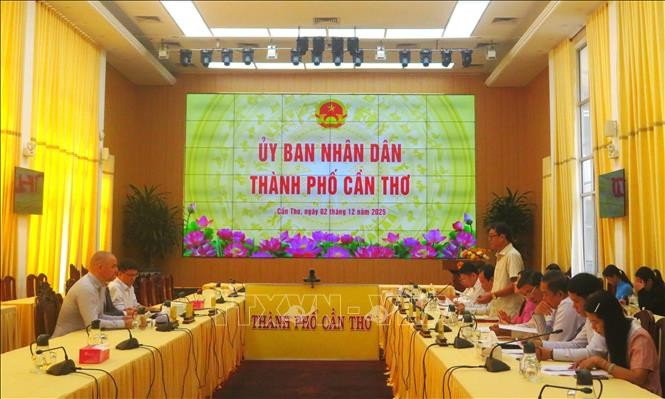
 The working session between the Can Tho People's Committee and Australia’s La Trobe University on December 2. (Photo: VNA)
The People's Committee of Can Tho city had a working session with Australia’s La Trobe University on December 2 to discuss ways to expand cooperation in developing high-quality education.
The event aimed to explore the possibility of establishing the first international-standard training institution of the Mekong Delta in this city.
Vice Chairman of the municipal People's Committee Nguyen Van Khoi said Can Tho aims to meet global education standards and develop a skilled workforce for integration and sustainable development. Cooperation with La Trobe, he noted, will support the city’s goal of becoming a regional centre for advanced training and research.
Christopher Piwarski, La Trobe’s Regional Director for East Asia, said the university, ranked among Australia’s top 20 and the world’s top 230, has more than 35,000 students and over 20 years of collaboration with Vietnam. It is shifting toward delivering programmes and awarding degrees directly in Vietnam and is considering establishing its first training facility in Can Tho.
La Trobe proposed the headquarters of former Hau Giang province's administration as a potential site, with priority fields including business, health, and information technology.
Tran Thi Huyen, Acting Director of the municipal Department of Education and Training, called for a cooperation roadmap featuring dual- or co-degree programmes, student exchanges, and scientific research partnerships in high-tech agriculture, AI, biomedicine, environment, and climate change.
The department also suggested creating a Can Tho – La Trobe training and research cooperation centre and expanding scholarships for local students.
The two sides agreed to consider launching an annual Can Tho – La Trobe academic forum to connect experts and promote new collaboration initiatives.
If implemented, the project would give the Mekong Delta its first international university campus, thereby reducing study-abroad costs, allowing students to earn foreign degrees locally, and improving the region’s human-resource competitiveness.
VNA