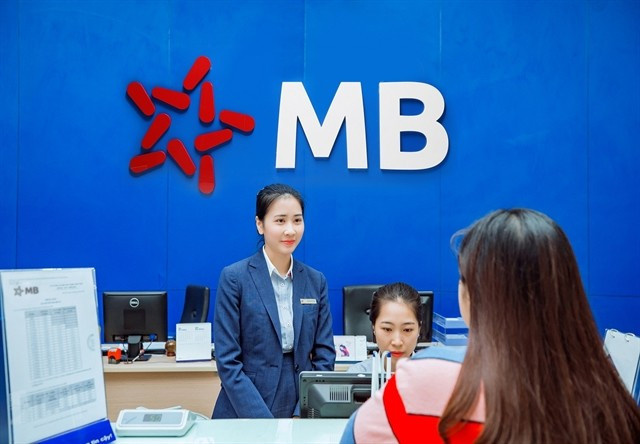
 Banks, including MB Bank, have issued alerts about scams conducted via social media platforms such as Zalo and Facebook, where criminals impersonate acquaintances. (Photo: The Courtesy of MBBank)
As the Lunar New Year (Tet) approaches, financial and banking scams in Vietnam are showing a sharp upward trend, prompting banks and law enforcement agencies to issue repeated warnings.
Banks, including MB Bank, have issued alerts about scams conducted via social media platforms such as Zalo and Facebook, where criminals impersonate acquaintances. (Photo: The Courtesy of MBBank)
As the Lunar New Year (Tet) approaches, financial and banking scams in Vietnam are showing a sharp upward trend, prompting banks and law enforcement agencies to issue repeated warnings.
According to alerts from police and commercial banks, a new scam has recently emerged involving the impersonation of a purported Government Tet support policy worth 400,000 VND.
Fraudsters often pose as local officials or representatives of Government agencies, contacting citizens by phone or text message to inform them that they are eligible for financial assistance.
Victims are then asked to verify information by providing one-time password (OTP) codes, bank account details or clicking on suspicious links. These allow criminals to siphon funds from their accounts. Such schemes particularly target the elderly and residents in rural, remote and mountainous areas.
Law enforcement authorities emphasise that legitimate state support programmes are implemented through official local government channels and never require citizens to disclose confidential information or complete online transactions to receive payments.
Authorities have also warned that scam groups are increasingly upgrading their methods through advanced technology. Fraudsters are now using artificial intelligence (AI) and deepfake technology to create highly convincing fake emails, messages, videos and voice recordings.
These tools are used to fabricate prize notifications, promotions or financial aid announcements. In some cases, they even mimic the voices of relatives or representatives of reputable organisations to deceive victims.
At the same time, fake websites and advertisements are becoming more sophisticated, often closely resembling the official sites of banks or major companies and differing only by a few characters in the domain name.
Phishing scams are also being deployed across multiple channels, including SMS, social media platforms, QR codes and automated bots, making it possible for victims to fall into a trap with just a single click.
Alongside high-tech scams, banks and authorities are also warning about fraudulent online loan offers circulating on social media.
Scammers advertise quick loans with simple procedures and low interest rates, then demand upfront deposits or fees under the guise of application processing, identity verification or loan insurance.
Once the money is transferred, the perpetrators immediately cut off contact and appropriate the funds.
Banks advise citizens to seek loans only from licensed credit institutions and financial companies and to never transfer deposits or advance fees to personal accounts or entities lacking clear legal credentials.
Meanwhile, banks continue to record numerous cases of customers receiving fake messages or calls impersonating bank brands. These communications typically claim that accounts are experiencing issues, require verification, need service upgrades or offer gifts or year-end refunds.
Vietcombank has warned that scammers often send links to counterfeit banking websites and ask customers to log in and provide OTP codes. Once the instructions are followed, the criminals quickly gain control of the accounts and carry out unauthorised transactions.
Similarly, the Joint Stock Commercial Bank for Investment and Development of Vietnam (BIDV) reports cases in which fraudsters impersonate bank staff, calling customers to offer financial support, service fee refunds or information verification, then requesting personal data, authentication codes or the installation of applications from unknown sources.
VietinBank and MB Bank have also issued alerts about scams conducted via social media platforms such as Zalo and Facebook, where criminals impersonate acquaintances or Government officials and send malicious links to take over user accounts.
Amid the increasingly complex nature of fraud, many banks have stepped up communication efforts, issuing warnings through their websites, digital banking applications and at transaction counters.
Banks collectively urge the public not to disclose personal information or OTP codes to anyone, not to click on links from unknown sources and not to install applications from unofficial platforms.
Upon receiving suspicious calls or messages, individuals should proactively verify the information through official bank channels or relevant authorities.
If signs of fraud are detected or losses have already occurred, citizens are advised to immediately contact their bank to block accounts and promptly report the incident to the nearest police authority for timely assistance.
According to the State Bank of Vietnam, as of December 28, 2025, the SIMO information system for customer risk management, monitoring and prevention had issued warnings to more than 2.4 million customers.
The system temporarily suspended or cancelled more than 776,000 transactions showing signs of risk, with a total value exceeding VNĐ2.9 trillion.
Le Van Tuyen, Deputy Director of the Payment Department at the State Bank of Vietnam, said that by December 26, 2025, the entire banking sector had completed biometric verification for more than 143 million individual customer records and over 1.5 million organisational customer records with payment accounts, using chip-based citizen ID cards or the VNeID application.
In addition, approximately 22.14 million individual e-wallet users and 392 organisational e-wallet users had completed biometric verification.
Meanwhile, the National Credit Information Centre (CIC), in coordination with the Ministry of Public Security, has conducted data cleansing involving around 57 million customer records.
VNA