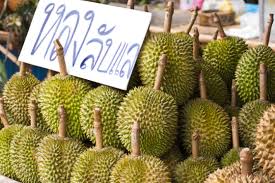
Thai Minister of Agriculture and Cooperatives Suriyas Junrungreangkit recently visited Chanthaburi province to inspect durian export activities and fruit quality control, reaffirming the country’s target of pushing durian export revenue beyond 150 billion THB (4.6 billion USD) in 2026.
Suriyas assessed that “quality and trust” will be key factors in retaining customers in China, Thailand’s largest export market.
According to the official, amid intensifying global competition, competitive advantage no longer lies solely in pricing, but also depends on food safety standards, traceability, and product reliability.
Suriya said durian is not only a key agricultural export but also an important economic asset, contributing to incomes for farmers, exporters and the logistics sector, while promoting Thailand’s culinary image in the global market.
According to the latest data from the Ministry of Agriculture and Cooperatives, Thailand has exported over 28,500 shipments of fresh durian, totaling more than 460,000 tons and generating over 52.5 billion THB in value. These figures reflect strong demand in international markets.
However, the Ministry acknowledges risks that could undermine partner countries’ confidence, particularly issues of illegal harvesting of unripe durians, detection of pests, chemical residues, including Basic Yellow 2 (BY2). The Chinese market has significantly tightened import standards recently.
To address these challenges, Suriyas instructed the Department of Agriculture to intensify quality control measures under the “Four No's” policy, which includes no unripe durians, no worms, no mislabeling or false claims, and no chemical residues.
Additionally, processes have been improved to facilitate exporters by implementing a 24-hour export facilitation system, increasing staff at inspection points, accelerating integration of the e-Phyto and TAS-License systems to enhance traceability, reduce redundancy, and solve goods backlog at checkpoints. Laboratory testing for chemical residues has been upgraded to meet Chinese authorities’ recommendations.
Simultaneously, the Ministry of Agriculture and Cooperatives unveiled model “Quality Durian Gardens” focusing on reducing chemical fertilizers and agricultural chemicals by promoting the use of biofertilisers, bioproducts, and organic fertilisers. This aims to raise Thai fruit safety standards and respond to the global green market trend.
VNA