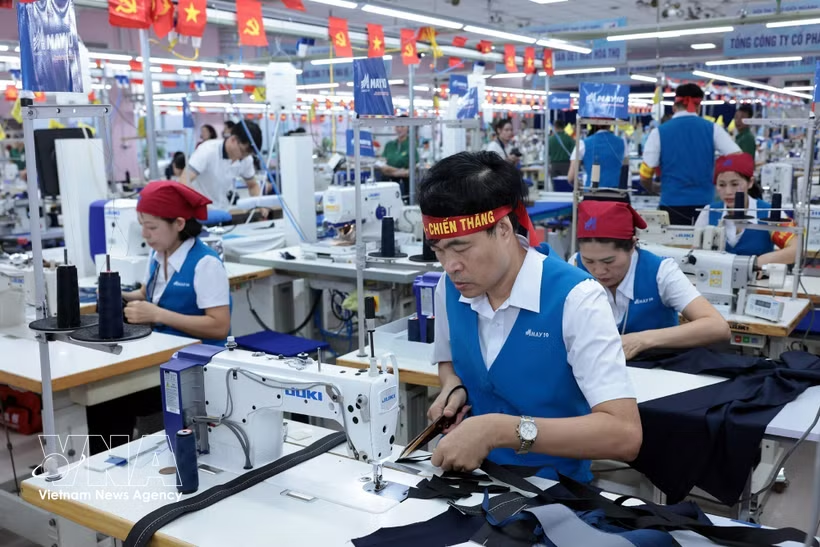
 As of September 15, preliminary data showed that the textile and garment industry’s export turnover had reached 33.66 billion USD. (Photo: VNA)
Facing global market volatility, rising costs and increasingly stringent international trade standards, Vietnam’s textile and garment industry is stepping up efforts to retain orders, diversify markets, increase the localisation of raw materials and accessories, and accelerate green and digital transformation.
These efforts are laying the foundation for greater production efficiency and competitiveness, with the sector targeting export revenue of 47–47.5 billion USD in 2026.
As of September 15, preliminary data showed that the sector’s export turnover had reached 33.66 billion USD, a result industry representatives attributed to progress based on three strategic pillars
First, the sector is continuing to diversify its markets, partners, customers and products. Vietnamese textile and garment products are now present 137 countries and territories. The US remains the largest market, accounting for about 40% of total overseas shipments, followed by traditional markets such as the EU, the Republic of Korea, Japan, China and ASEAN, as well as promising emerging markets in Africa and the Middle East.
Second, enterprises are accelerating the application of technology, automation, robotics and artificial intelligence (AI) to management and production. These technologies are helping improve productivity, optimise production processes and enhance operational efficiency.
Third, the sector is strengthening links across the value chain to build sustainable supply chains, enabling businesses to support one another and improve overall competitiveness.
Chairman of the Vietnam Textile and Apparel Association (VITAS) Vu Duc Giang said the sector’s performance reflects the combined impact of flexible strategies, enterprises’ adaptability and progress in green and digital transformation.
Looking towards 2026–2030, with a vision to 2035, Giang stressed that digital and green transformation are no longer options but essential requirements for textile and garment enterprises.
In digital transformation, they are investing heavily in infrastructure and applying AI and robotics to production. According to VITAS, investment in these areas currently accounts for around 65–68% of total investment at many enterprises.
At the same time, green transformation has become a long-term priority in line with the Government’s net-zero emissions target for 2050. Enterprises are gradually investing in renewable energy, including rooftop solar power, upgrading wastewater treatment systems and increasing the use of environmentally friendly materials.
Giang called on localities to develop specialised industrial parks with concentrated wastewater treatment systems meeting international standards. This will help attract secondary investors in textile and dyeing and gradually address bottlenecks in domestic supplies of raw materials and accessories.
Amid competition from major production centres such as Bangladesh and India, he said Vietnam has its own advantages, particularly in the mid- and high-end segments.
Rather than competing mainly on price, Vietnamese businesses are targeting orders requiring advanced technical skills, high-quality workmanship, fast delivery and strict quality standards. A stable socio-economic environment and Vietnam’s participation in 17 new-generation free trade agreements (FTAs) also provide favourable conditions for deeper access to international markets.
From the business perspective, Than Duc Viet, General Director of Garment 10 Corporation JSC, said the company is accelerating the use of technology and automation on production lines to improve productivity and meet increasingly demanding requirements on delivery times and quality.
Coordinated investment in digital and green transformation has helped Garment 10 maintain stable production, optimise operating costs and secure jobs for workers, he said.
Thanks to proactive negotiations and improved competitiveness, the firm has secured orders through the end of 2026 and is negotiating contracts for the first quarters of 2027.
Meanwhile, Cao Huu Hieu, General Director of the Vietnam National Textile and Garment Group (Vinatex), said the focus for the final months of the year is on tight cost control, higher productivity, cash-flow management and high-value-added orders.
Several major Vinatex members, including Garment 10, Nha Be Garment and Hue Textile – Garment, have secured orders through the end of the year.
However, Hieu noted that having orders does not mean pressure has eased as customers continue to seek longer delivery periods, push harder on prices and shift towards products with more complex technical requirements.
Businesses therefore need to actively coordinate orders across the system to maximise production capacity while preparing early for 2027.
With current progress and enterprises’ proactive approach, the industry considers its 2026 export target of 47–47.5 billion USD achievable. If market conditions improve in the fourth quarter, turnover could even approach 48 billion USD.
VNA