For the “Sustainable Development of One Million Hectares of High-Quality, Low-Emission Specialized Rice Cultivation Associated with Green Growth in the Mekong Delta Region through 2030” Project (One-Million-Hectare Rice Project) to continue delivering results, stronger and more durable partnerships between farmers and agribusinesses are essential.
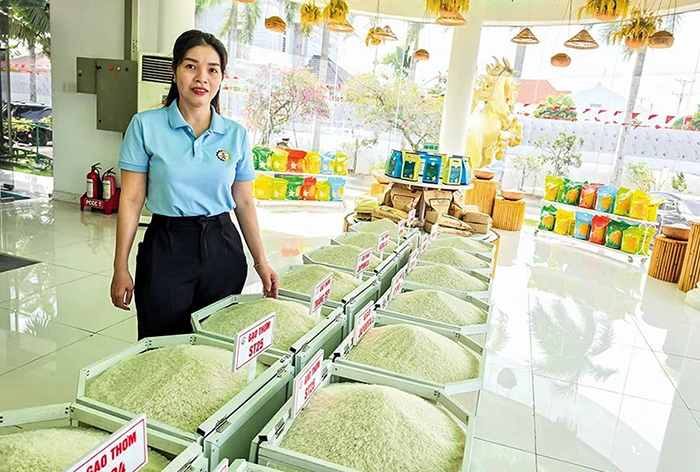
By partnering with farmers from many cooperatives in the Mekong Delta, Trung An High-Tech Agriculture Joint Stock Company in Can Tho City has produced a range of green, low-emission rice products serving both domestic and export markets.
Forging tighter linkages is crucial
After over two years in operation, the One-Million-Hectare Rice Project has delivered tangible results. The area under sustainable cultivation protocols introduced by the Project, either fully or partially applied, has exceeded 420,000 hectares. Farmer profits under the model increased by VND 1.5-9.3 million per hectare per crop, while emissions were cut by 3-4 tonnes of CO₂ equivalent per hectare per crop. The model has also helped tighten integration across the value chain.
The evidence on the ground points to the steady formation of a value chain for high-quality, low-emission rice. Many localities have proactively undertaken planning reviews, established centralized production zones, standardized farming procedures, and enlisted the participation of relevant stakeholders… However, in many areas, linkages among enterprises, cooperatives and producers remain confined to spot sales or short-term contracts, falling short of fostering long-term cooperative relationships. When paddy prices rise sharply, farmers tend to break their commitments and sell outside the chain. Conversely, during market downturns, enterprises face difficulties in upholding contracted prices, leaving linkages prone to collapse.
According to the Department of Cooperative Economy and Rural Development (Ministry of Agriculture and Environment), the initial stage of the One-Million-Hectare Rice Project has largely succeeded in tackling the formation and expansion of production areas. However, the phase toward 2030 calls for a fundamental shift: from area expansion to value chains, from purely “production zones” to “investment-ready raw material regions” connected to markets, data, guaranteed off-take agreements, leveraging the pivotal role of cooperatives and enterprises, and unlocking capital flows.
Ms. Nguyen Thi Hoang Yen, Deputy General Director of the Department of Cooperative Economy and Rural Development, said: “An investment-ready raw material region is one with a clearly defined spatial plan, delineated boundaries and geographic location; it is standardized to meet requirements for irrigation, on-farm transportation and logistics, and digitized with a transparent database that allows enterprises to readily engage and invest”. According to Ms. Yen, based on the results achieved, the Department will continue to advise competent authorities on mechanisms and policies to effectively implement the One-Million-Hectare Rice Project for the 2026-2030 phase.
Leveraging the Role of Cooperatives
To effectively implement the One-Million-Hectare Rice Project, it is necessary to strengthen production-consumption linkages along the value chain to secure off-take and give farmers confidence in production. Relevant authorities should provide support to enhance capacities, enabling cooperatives to boost digital technology adoption for transparent production processes and stronger linkages with enterprises through contracts.
Mr. Doan Tan Dat, Director of Tan Dat Agricultural and Service Cooperative in Vinh Long Province, noted: “To establish a sustainable rice production and off-take chain in the regions under the One-Million-Hectare Rice Project, it is necessary to leverage the role of cooperatives as a bridge connecting farmers with purchasing, processing and export enterprises. It is necessary to create conditions for cooperatives to enhance their operational capacity, pooling members and farmers for production in compliance with technical protocols… thereby helping to reduce costs, generate large volumes of commodities with traceability and guaranteed quality and safety, meet export orders, and contribute to raising the value of rice grains”.
According to Mr. Pham Thai Binh, Chairman of the Board of Directors of Trung An High-Tech Agriculture Joint Stock Company, there should be close coordination among the key actors of the Project - farmers, cooperatives and enterprises. Such linkages should be geared toward developing sustainable raw material zones. Beyond guaranteeing off-take for farmers in cooperatives within the raw material zones, enterprises also need to provide guidance on farming techniques and support the supply of seeds and agricultural inputs. To achieve this, enterprises require substantial capital and therefore need the authorities to promptly remove bottlenecks.
Concerning the One-Million-Hectare Rice Project, Mr. Tran Minh Hai, Vice Chairman of the Vietnam Rice Industry Association, noted that efforts should center on improving off-take to generate higher incomes for farmers and enhance added value for participants in the rice cultivation chain toward sustainable production. Enterprises and cooperatives should be encouraged to forge close linkages via production and consumption contracts right from the start of the season.
KHÁNH TRUNG (Translated by MAI QUYEN)






Director: HUYNH HOANG MEN
The license No 789/GP-BTTTT issued by... on Dec 2, 2021
Address: 24 Tran Van Hoai street, Can Tho city - Tel: (0292) 3830098 - Fax: (0292) 3830561 - Email: toasoan@baocantho.com.vn
Contact to Ads: quangcao@baocantho.com.vn
Developed by:


