The implementation of the "Sustainable Development Project for One Million Hectares of High-Quality, Low-Emission Rice Cultivation Associated with Green Growth in the Mekong Delta by 2030" (the Project) in Can Tho City has been yielding significant economic benefits. The Project not only helps modernize production but also enhances the value of rice grains and aims for green growth.
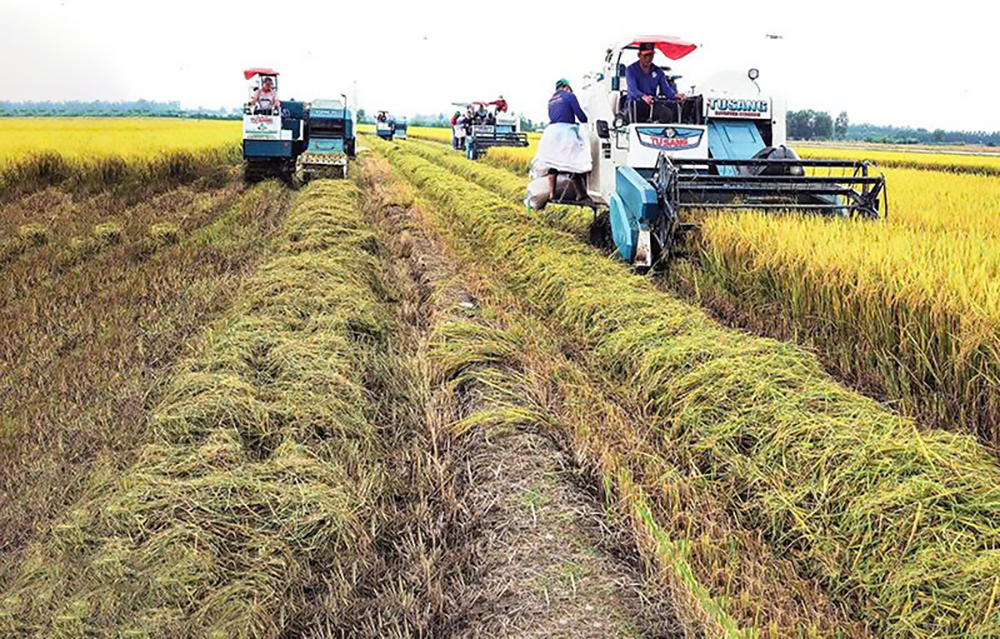
Mechanized rice harvesting at the high-quality, low-emission rice production model at Tien Thuan Cooperative in Thanh Quoi commune.
Over the past two years of implementing the Project, functional agencies in the city have coordinated with the Ministry of Agriculture and Environment, other central ministries and agencies, and businesses to support farmers in cooperatives in implementing 12 pilot models in accordance with the Project's criteria (each model covering 50 hectares). Additionally, the Department of Agriculture and Environment of Can Tho City has developed many high-quality, low-emission rice production models in various localities, with all of which having yielded high economic efficiency.
These models enable farmers to simultaneously apply technical advancements and mechanization, thereby modernizing production and reducing costs. By strengthening supply chain linkages, they produce high-quality, safe rice that meets market demands.
The models also help farmers reduce the use of rice seeds, fertilizers and pesticides, implement Alternate Wetting and Drying (AWD) irrigation, and eliminate field straw burning, significantly cutting greenhouse gas emissions.
Mr. Huynh Van Dung, Chairman of Kien Thanh Agricultural and Service Cooperative in Vi Thanh 1 commune, said that applying the cultivation techniques of the One Million Hectares of High-Quality, Low-Emission Rice Project has boosted household profits by 20-30% due to reduced costs, improved productivity and product quality.
According to the Department of Agriculture and Environment of Can Tho City, high-quality, low-emission rice production models help increase profits by at least 20% compared to traditional farming models, while reducing emissions by 2-12 tons of CO2/ha. Farmers in the pilot models have seen their profits rise by 1.3-6.5 million VND/ha.
Ms. Tran Thi Kim Thuy, Deputy Head of the Crop Production and Plant Protection Sub-Department, said: “According to statistics from 12 pilot models implemented in the 2024-2025 period and many models that replicated in the 2025-2026 Winter-Spring crop, production costs dropped by an average of 1.1 million VND/ha. Farmers reduced the amount of rice seeds by 50%; the amount of nitrogen fertilizer by 30% and the number of pesticide sprays by 2-3 times, and the amount of irrigation water by 30-40%. Furthermore, with 100% of participants utilizing high-quality, certified seeds, rice yields have increased by 0.3-0.7 tons/ha. The model has demonstrated clear economic benefits compared to traditional farming methods”.
By the end of 2025, Can Tho City have established 104,500 hectares of high-quality rice cultivation. The goal for 2026 is to maintain a specialized area of 76,000 hectares. By 2030, the city aims to expand to over 170,870 hectares of specialized rice cultivation areas across 64 communes and wards, attracting 171 cooperatives and cooperative groups. To achieve this roadmap, the Department of Agriculture and Environment is actively supporting farmers in data standardization, origin tracing, and the implementation Measurement, Reporting, and Verification (MRV) practices to prepare for the carbon credit market.
Despite these positive results, experts acknowledge that the locality still faces several infrastructure hurdles. In many areas, transportation and irrigation systems are not yet synchronized, hindering the application of Alternate Wetting and Drying (AWD) irrigation techniques. Furthermore, straw collection remains difficult due to a shortage of baling machines, meaning farmers have not fully exploited the value chain of this byproduct. In the future, the city needs to strengthen linkages between cooperatives and agribusinesses, while prioritizing targeted investments in irrigation infrastructure to ensure long-term sustainable farming.
KHANH TRUNG (Translated by Thanh Truc)







Director: HUYNH HOANG MEN
The license No 789/GP-BTTTT issued by... on Dec 2, 2021
Address: 24 Tran Van Hoai street, Can Tho city - Tel: (0292) 3830098 - Fax: (0292) 3830561 - Email: toasoan@baocantho.com.vn
Contact to Ads: quangcao@baocantho.com.vn
Developed by:


