At the meeting and connection program between Can Tho City leaders and Japanese partners held on September 11th, investors' interest has entered a new phase: shifting from exploring potential to focusing on specific projects with connectivity and long-term development.
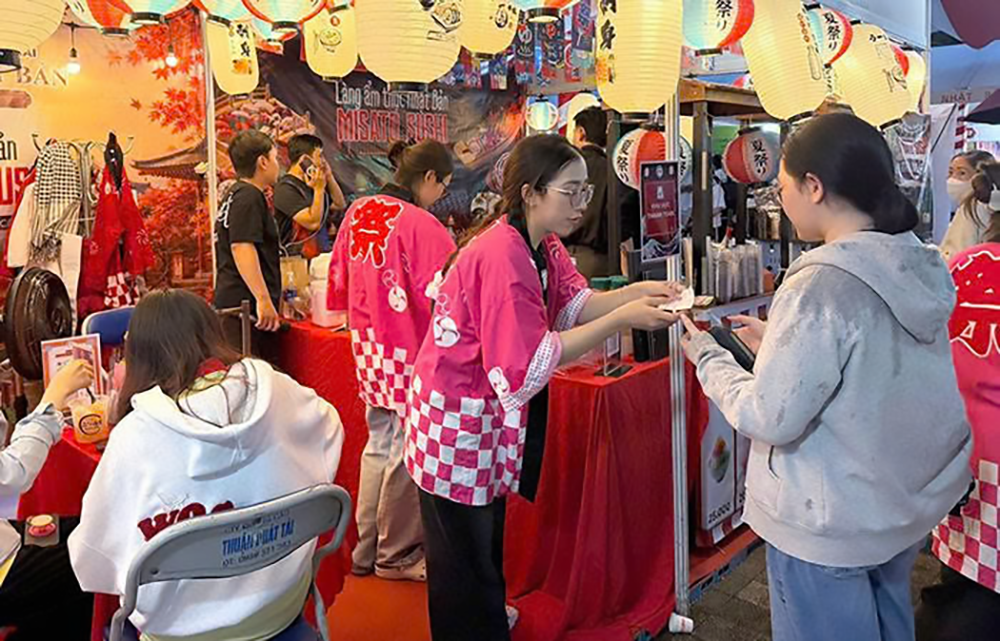
Trade activities at the 2026 Vietnam-Japan Cultural and Trade Exchange Program in Can Tho City.
Expanding cooperation space
According to Mr. Okabe Mitsutoshi, Head of the JETRO Office in Ho Chi Minh City, Vietnam is highly attractive to Japanese businesses. A survey published by JETRO in November 2025 shows that nearly 60% of Japanese companies in Vietnam surveyed plan to expand their business within the next 1-2 years, the highest among ASEAN countries.
In this trend, the Mekong Delta emerges as a new growth space. Not only is it a key area for agriculture and fisheries with internationally competitive industries such as rice, fruits and seafood, but it also possesses infrastructure that is gradually being completed, including highways, seaports and airports.
As a result, the region is expected to shift from a purely production area to a center for deep processing and logistics. Notably, according to the June 2026 online survey by JETRO, Can Tho ranks third in the level of interest among Japanese businesses, after Ho Chi Minh City and Dong Nai.
A JETRO representative noted that as labor costs rise and recruitment becomes increasingly difficult, the appeal of the Mekong Delta will continue to grow. Some Japanese enterprises in Ho Chi Minh City have begun considering relocation, as land leases in certain industrial parks are set to expire starting from 2040.
According to Mr. Pham Hong Diep, Chairman of the Board of Directors of Shinec Joint Stock Company, the new development space created by Can Tho’s consolidation fosters connections between the central urban area, agricultural and aquatic raw material zones, industrial and logistics sectors, and the sea. If properly organized, these components will form a value chain from raw materials, research, production, processing to logistics and export.
Shinec aims to develop Dong Phu Eco-Industrial Park into a destination for Japanese enterprises specializing in high-quality food processing, preservation technology, cold storage, agricultural machinery, automation, robotics, electrical and electronic equipment, and logistics. These sectors help complete the missing links in the Mekong Delta’s agricultural value chain, particularly by enhancing product value and reducing post-harvest losses.
At Can Tho University, JICA has had a decades-long partnership, ranging from infrastructure support and training to ODA projects and technical cooperation. The 2022-2027 period focuses on strengthening links between the government, the university and businesses, aiming to develop sustainable agriculture and fisheries and adapt to climate change.
Removing bottlenecks and attracting Japanese investment
If potential is a necessary condition, the investment environment and the ability to implement new projects are decisive factors driving actual capital inflows into Can Tho. This concern was echoed by Japanese representatives at the meeting and connection program between Can Tho City leaders and Japanese partners.
Mr. Ueda Masaya, Secretary General of the Japan Business Association in Ho Chi Minh City (JCCH), stated that the city needs to pay more attention to infrastructure; maintain reasonable land rent prices; expand international flight routes; continue to improve the living environment, schools, healthcare, housing, and services for foreign experts and their families. According to Mr. Ueda Masaya, these recommendations also aim to transform Can Tho into a highly attractive destination for Japanese investors.
In addition to developing infrastructure, the JETRO Chief Representative believes that the core is to improve the business environment so that Japanese companies can invest with confidence and operate stably. In particular, the city needs to pay attention to the level of satisfaction of Japanese businesses investing in Can Tho, as they will contribute to building trust and attracting new investments.
Regarding domestic enterprises, Shinec proposes innovating investment attraction strategies by synchronizing institutional frameworks, improving infrastructure connectivity in industrial zones, while training human resources to meet the standards and skills required by Japanese companies.
Investment promotion efforts should focus directly on specific industries and projects with detailed data instead of general advertising. The company also proposes developing “Japan - Mekong Green Manufacturing Gateway” program to support investors from the initial approach to project operation, including bilingual consulting panels, a “soft landing” program to assist Japanese small and medium-sized enterprises (SMEs), connecting suppliers and supporting technology transfer.
Ms. Nguyen Ngoc Diep, Deputy General Director in charge of production at Hau Giang Pharmaceutical Joint Stock Company, stated that the company always considers technology, production capacity and quality standards as the foundation to enhance competitiveness. Based on that, Hau Giang Pharmaceutical hopes to expand cooperation with Japanese partners in the pharmaceutical industry under the motto “trust, quality, long-term, and mutual growth”.
Discussions during the program showed that the cooperation opportunities between Can Tho and Japan have moved beyond the scope of isolated FDI projects toward a larger goal: creating a closely linked ecosystem among raw material regions, processing enterprises, supporting industries, logistics, universities, research institutes, finance, and technology… The challenge for Can Tho lies in transforming this potential into concrete projects with specific locations, timelines and partners.
Proactively resolving bottlenecks regarding connectivity infrastructure, land availability, and administrative reform serves as the foundation for Can Tho City to transform the wave of Japanese investment into a new growth engine, befitting its status as the hub for innovation and deep processing in the Mekong Delta.
NAM HUONG (Translated by THANH TRUC)




Director: HUYNH HOANG MEN
The license No 789/GP-BTTTT issued by... on Dec 2, 2021
Address: 24 Tran Van Hoai street, Can Tho city - Tel: (0292) 3830098 - Fax: (0292) 3830561 - Email: toasoan@baocantho.com.vn
Contact to Ads: quangcao@baocantho.com.vn
Developed by:


