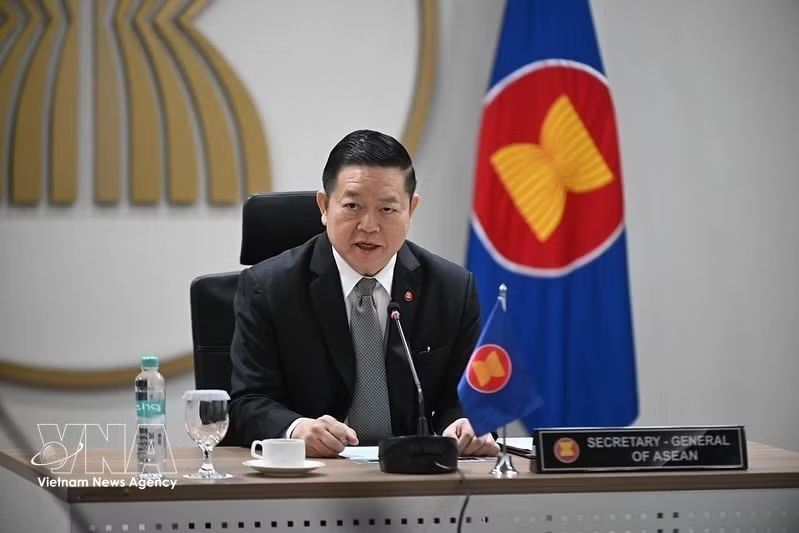
ASEAN Secretary-General Kao Kim Hourn (Photo: VNA)
The 49th ASEAN Summit doubles as Timor-Leste’s first anniversary as the bloc’s 11th member, a milestone that completes ASEAN’s map across Southeast Asia.
ASEAN Secretary-General Kao Kim Hourn told the Vietnam News Agency (VNA) that the enlargement adds scale and pressure, with more opportunities but also harder work on solidarity, development gaps and ASEAN’s central role in regional architecture.
Kao described Timor-Leste’s entry a historic milestone, fulfilling the founders’ vision of a united, inclusive Southeast Asia. ASEAN’s emblem and flag now carry 11 rice stalks in one circle, one for each member.
The new emblem signals an ASEAN that is growing more inclusive while holding to its founding principles of building a peaceful, stable, dynamic region based on equality and cooperation. Its colours come from member states’ national emblems, reflecting diversity inside a single community.
ASEAN’s identity has evolved, but its operating principles remain, including sovereignty, non-interference, consensus and mutual benefit. The bloc’s ability to add members without diluting nearly 60 years of values is the point.
An 11-member Community widens the opportunity set across trade, investment, tourism, connectivity, education, health, climate change response and people-to-people ties. For Timor-Leste, it means deeper access to regional economic, connectivity and capacity building schemes. For existing members, it adds geography, population and more perspectives in shaping common stances.
The three ASEAN Community pillars of politics-security, economy and socio-culture can now be rolled out more fully across Southeast Asia. That reinforces the commitment to a region where every member has a seat, a voice and responsibility for the common interest.
On regional architecture, Kao said Timor-Leste’s accession reinforces ASEAN’s central role in shaping Southeast Asian relations and cooperation with external partners. That role depends less on declarations than on solidarity and the ability to settle differences and disputes peacefully.
Inclusiveness, openness and consensus-based decision-making remain ASEAN’s selling points for partners seeking regional dialogue and cooperation. Expanding to 11 members shows the bloc can adapt and transform while feeding into wider structures, from the East Asia Summit to ASEAN-centred free trade frameworks.
With the 60th anniversary and ASEAN Vision 2045 under the theme “Our Common Future” ahead, Kao says the 11-member Community must aim for a resilient, innovative, dynamic, inclusive and people-centred region. That requires close coordination, a narrower development gap, stronger response capacity for new challenges, more physical and digital connectivity, and wider distribution of integration benefits.
Economic integration needs to go deeper so companies and workers in all 11 countries can plug more fully into regional value chains. ASEAN also needs faster connectivity projects to cut travel and transport costs, strengthen community links and build resilience against disruptions. Climate response, disaster management and sustainable development need more attention because no single country can solve them alone.
Another priority is investing in future generations through education, skills and people-to-people exchanges to build a stronger sense of regional belonging. According to him, these are not abstract goals but concrete actions to improve daily life across the ASEAN Community.
In a message to ASEAN member states and citizens, he said the road ahead will be difficult. But nearly 60 years of history show that sustained, consistent collective effort can overcome differences and produce real progress. With guidance of member states and partner support, ASEAN will keep building a united, resilient, dynamic, inclusive and future-oriented 11-member Community for Southeast Asians today and future generations.
VNA