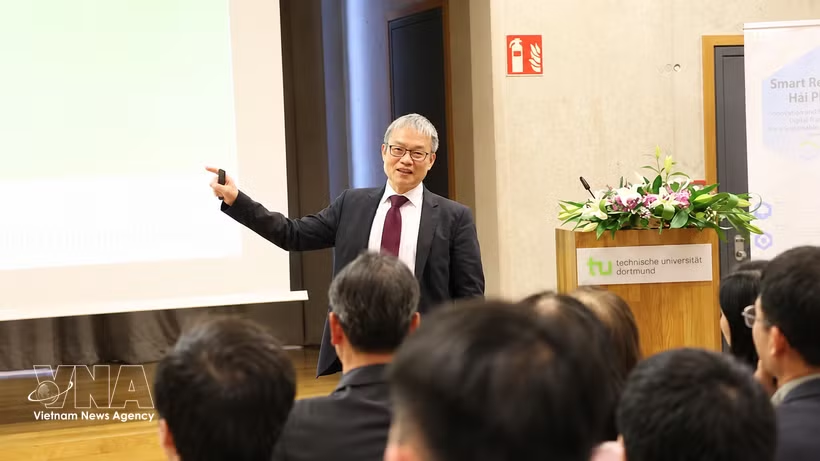
Prof. Dr. Nguyen Xuan Thinh, a TU Dortmund lecturer, speaks at the event (Photo: VNA)
More than 100 scientists, experts, doctoral researchers, students and representatives of Vietnamese and German bodies and enterprises gathered at TU Dortmund University on November 8 for the 2026 Vietnam intellectuals’ forum in North Rhine-Westphalia (NRW) state.
Deputy Director of the Executive Agency of the National Foundation for Science and Technology Development (Nafosted) Nguyen Phu Binh and Deputy Director of the National Innovation Centre (NIC) Kim Ngoc Thanh Nga joined online from Vietnam. The event marked the launch of the Vietnamese Intellectuals’ Network in NRW, designed to pool brainpower and drive research cooperation, technology transfer and innovation between the two countries.
It was co-hosted by TU Dortmund, the Vietnamese Embassy in Berlin’s science and technology section, the Vietnamese Consulate General in Frankfurt, the Vietnamese Association in NRW, the Vietnamese Students’ Association in the Ruhr region and the Vietnam–Germany Innovation Network (VGI).
In his opening speech, Prof. Dr. Nguyen Xuan Thinh, TU Dortmund lecturer, VGI Chairman and acting President of the Federation of Vietnamese Associations in Germany, said the strong turnout shows clear demand for connection, a desire to contribute and a growing cooperative spirit among Vietnamese intellectuals in Germany. He said the NRW network, a VGI branch, is a new step to regularly connect Vietnamese scientists, experts and intellectuals in the state, leverage individual strengths and carry out practical cooperation.
Vietnamese Consul General in Frankfurt Luu Xuan Dong said with Vietnam treating science, technology and innovation as a strategic breakthrough, the intellectual resources of overseas Vietnamese, especially those in Europe and Germany, matter greatly.
According to him, the network should focus on gathering young Vietnamese intellectuals and experts in NRW, leveraging the state’s and individuals’ strengths to connect and roll out projects in Vietnam, while encouraging entrepreneurship and giving students and young people room to join. The Vietnamese Consulate General in Frankfurt will keep supporting the network’s links with domestic agencies, Vietnamese localities and German partners.
Speaking online from Vietnam, Binh made four proposals to Vietnamese-origin experts and intellectuals in Germany. These include jointly developing Vietnam–Germany research topics, validating and commercialising technology, training the next generation of scientists, and improving evaluation quality by joining scientific councils or serving as independent reviewers.
Nga urged scientists to proactively propose specific technology solutions and cooperation agendas and deepen exchanges with domestic research institutes, universities and firms to identify suitable technologies with commercialisation potential for Vietnam.
NIC pledges to connect experts with specialised networks and domestic partners. The centre is building specialised networks in strategic technology fields, including semiconductors, artificial intelligence, quantum technology, cybersecurity and unmanned aerial vehicles, and wants stronger coordination between VGI and those networks to link German-based experts with Vietnam’s practical needs, she said.
Vietnamese Counsellor of Science and Technology in Berlin Ha Thi Lam Hong presented Vietnam’s priority sci-tech fields, cooperation mechanisms, funding ecosystem and research resources, along with national-level sci-tech schemes.
Le Thanh Nam, Chairman of the Vietnamese Association in NRW, said the community has many professors, doctors, scientists, experts and entrepreneurs contributing to science, technology, education, health and the economy. That is a valuable intellectual resource, he said, but it needs a mechanism to turn talented individuals into collective strength.
He also stressed coordination between intellectuals and businesses. Scientists bring knowledge, technology and creative ideas while firms hold practical experience, resources and the ability to put ideas into practice. Partnering the two sides can turn research into products and create practical socio-economic value.
NRW is Germany’s most populous state, with about 18 million people, and one of the country’s key industrial, education and research hubs. Universities such as RWTH Aachen, TU Dortmund, Ruhr University Bochum and the University of Bonn have drawn generations of Vietnamese to study, research and work in technology, health, environment and economy.
Dr. Vu Thi Thanh Huong, Secretary General of the Vietnamese Association in NRW, said the network’s initial database recorded 87 members as of October 31, 2026. Of those, 55 are professors, associate professors, doctors or master’s degree holders, or more than 63%, with the rest bachelors, engineers, doctors and students.
VNA