According to experts, the Mekong Delta’s economy is approaching its growth ceiling, making it increasingly difficult to sustain high growth by relying solely on traditional growth drivers. To unlock a new phase of economic development in the region, one decisive factor is the production and business performance of the local business community. Consequently, regional enterprises must proactively embrace science and technology, pursue innovation and digital transformation, strengthen regional linkages, and leverage stronger support and partnership with local authorities.
Identifying weak links
According to the Vietnam Chamber of Commerce and Industry (VCCI), the number of newly registered businesses in the Mekong Delta surged by approximately 66% in 2025, compared with a 24% increase nationwide. However, the average registered capital per enterprise was only around VND 5.8 billion, less than half the national average of VND 12.6 billion. This highlights the region's heavy reliance on micro- and small-sized enterprises.
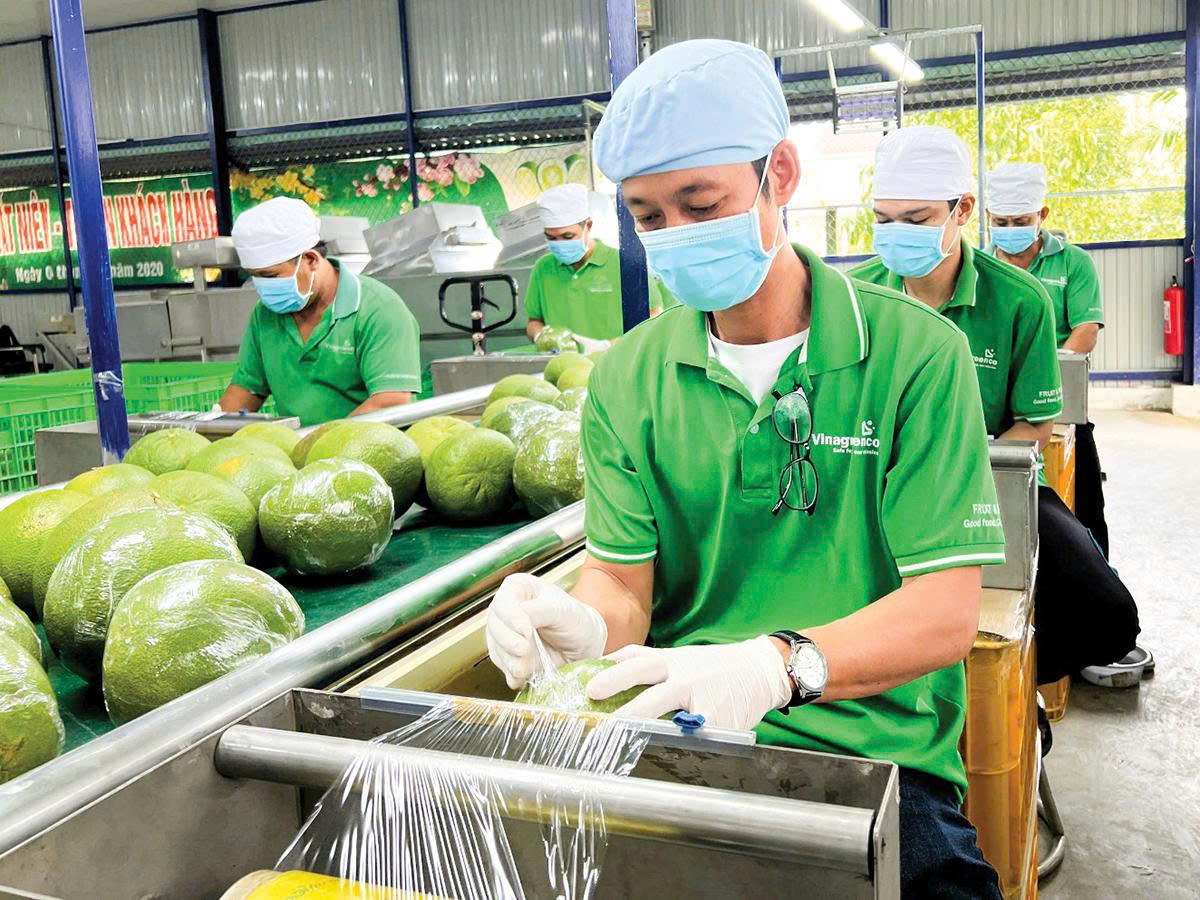
Production activities at Vinagreenco JSC, Can Tho City. Photo: MY THANH
Nguyen Phuong Lam, Director of the VCCI Mekong Delta Branch, said the region had several rice and seafood businesses that were expanding and establishing distinctive market positions. However, the broader picture remained challenging, as the region lacked a sufficient number of enterprises with strong capabilities and the capacity to apply science and technology.
Moreover, only around 10% of small businesses in the Mekong Delta scale up to become medium-sized enterprises each year. This means that without a stronger base of medium-sized businesses, the region will struggle to grow large-scale enterprises. Meanwhile, an economy without large businesses to lead the way is unlikely to achieve breakthrough growth, he noted.
Dau Anh Tuan, VCCI Deputy Secretary-General and Head of its Legal Department, said the Mekong Delta accounted for 5% of Vietnam’s total exports in 2024. This share fell to approximately 4.5% in 2025 and dropped further to 4% in the first nine months of 2026. These figures indicate that the region’s contribution to the country’s export value is gradually diminishing.
In addition, the Mekong Delta’s exports grew by just 4.6% in 2025, compared with 17.1% nationwide. This reflects a structural weakness: the region’s export products remain insufficiently processed, businesses make limited investments in machinery and technology, and their integration into global value chains remains relatively shallow.
Unlocking new growth drivers
Seeking solutions to the Mekong Delta’s growth challenges, Lam Thuy Ai, General Director of Mebi Farm Joint Stock Company, said the region was wasting its natural resources. In agriculture, for example, circular economy practices have yet to be widely adopted, with some production activities implementing them only partially.
If the region effectively applied science and technology to process agricultural and aquaculture by-products, it could generate products with significantly higher added value. However, she argued that businesses needed financial support from the state budget to fund research, digital transformation and circular economy initiatives, enabling them to achieve the desired outcomes.
According to Vo Quoc Thang, Chairman of the Board and General Director of Dong Tam Joint Stock Company, the Mekong Delta has received special attention from the Party and State regarding infrastructure investment in recent years. To promote economic development across the region, businesses must strengthen trade and commercial connectivity. In particular, Ho Chi Minh City, Tay Ninh, Dong Nai and the Mekong Delta need to forge closer links.
“Businesses must pursue development strategies that aim to help other enterprises and the Mekong Delta as a whole grow. I personally made a substantial investment in building a port to help drive the region’s development. If I were concerned only with my own interests, I would not have invested. In fact, four investors had already withdrawn, and for nearly 20 years, no one else was willing to step up”, Vo Quoc Thang said.
Truong Canh Tuyen, Chairman of the Can Tho City People’s Committee, said the city was working to renew traditional growth drivers while gradually harnessing new ones more effectively, including science and technology, digital transformation, the green economy and circular economy.
For investment projects, the city will continue to review and provide support within its authority and in accordance with the law, while placing particular emphasis on technology oversight, environmental protection and long-term investment efficiency, he said.
“The city hopes the business community will continue to work alongside the authorities, share information and proactively report difficulties and obstacles so that the government can promptly review and address them. This will help strengthen government-business collaboration, maximize the potential and competitive advantages of individual localities, and generate fresh momentum for the Mekong Delta’s sustainable development”, Truong Canh Tuyen stressed.
MY THANH (Translated by Thanh Truc)










Director: HUYNH HOANG MEN
The license No 789/GP-BTTTT issued by... on Dec 2, 2021
Address: 24 Tran Van Hoai street, Can Tho city - Tel: (0292) 3830098 - Fax: (0292) 3830561 - Email: toasoan@baocantho.com.vn
Contact to Ads: quangcao@baocantho.com.vn
Developed by:


