The agriculture sector of Can Tho City considers digital transformation a shift from manual, experience-based management to data-driven governance. The goal is to boost efficiency, lower production costs and emissions, while enhancing transparency to fulfill the requirements of green and modern agriculture.
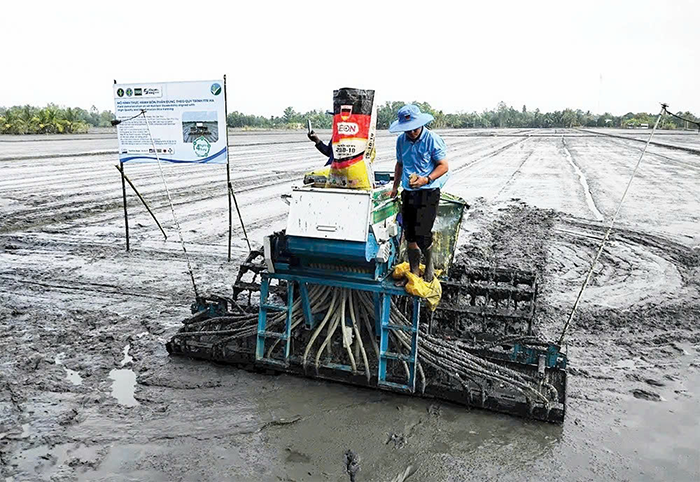
The row-seeding model for cost-saving in rice production has been deployed across Can Tho City.
Digital Transformation in Crop Production
Mr. Thai Thanh Tan, Deputy Director of the Can Tho City Crop Production and Plant Protection Sub-department, said that digital transformation has become an inevitable trend in modern agriculture. Under the Project on Sustainable Development of one million hectares of high-quality, low-emission rice cultivation associated with green growth in the Mekong Delta by 2030 (The one million hectares rice project), which is currently being implemented, the digitalization of production data is a pressing requirement for managing production, monitoring greenhouse gas emissions, ensuring traceability, operating the MRV system (Measurement, Reporting and Verification) and carbon credit development. Such an initiative will enhance production efficiency, ensure transparency across the value chain and promote the sustainable development of the rice sector.
According to the Can Tho City Crop Production and Plant Protection Sub-department, local rice farming is facing multiple challenges from climate change, escalating production costs, heightened market requirements regarding quality, information transparency and green growth. In response to the aforementioned requirements, the Sub-department has coordinated with the International Rice Research Institute (IRRI), Can Tho University, enterprises and cooperatives to concurrently deploy various digital platforms, including FarMoRe, Rice Crop Manager (RCM), the ViRiCert tool for assessing compliance with the one million hectares rice project, IoT-based sensor systems for Alternate Wetting and Drying (AWD) irrigation management, electronic farm record-keeping, GIS digital maps serving the MRV system and other production management tools.
Since 2025, the Can Tho City Crop Production and Plant Protection Sub-department has coordinated with IRRI to synchronously implement research, pilot trials and expand the application of RCM. Implementation activities comprised of the establishment of 24 on-farm experimental models in communes across Can Tho City to validate and refine fertilizer recommendations; the delivery of a Training-of-Trainers course for 110 technical officers; the organization of 49 training sessions for approximately 3,000 technical officers, farmers and rice value chain stakeholders in Can Tho; and the conduct of 3 pilot evaluation sessions with 150 farmers prior to scaling up the application. Results show that RCM is highly practical, easy to use and widely adopted by farmers and technicians. It contributes to enhancing fertilizer use efficiency, lowering production costs and advancing digital transformation toward high-quality, low-emission rice production.
Leveraging Effectiveness
As of now, Can Tho City has a total rice-growing area of 608,546 ha and an annual output exceeding 2.3 million tons. The one million hectares rice project has been deployed across 65 communes and wards, covering a total area of over 170,000 ha to ensure production that meets safety and high-quality standards with secured product consumption. Mr. Thai Thanh Tan further stated: “The application of digital transformation in crop production and plant protection is becoming easier thanks to improved information technology infrastructure, the synchronous deployment of databases and integrated software, as well as the engagement of farmers, cooperatives and enterprises”. Applications such as production area code management, electronic field record-keeping, traceability systems, pest and disease forecasting and smart farming equipment have contributed to enhancing management efficiency, reducing production costs, meeting market requirements and facilitating the modernization and sustainability of agriculture.
Up to now, the city's Department of Agriculture and Environment has granted 544 production area codes across 11,161 ha with a total harvested output of 198,657 tons. The work of granting packing facility codes has also been implemented synchronously, with a total of 125 codes issued to 17 enterprises, helping to secure safe production, enable product traceability and satisfy export market requirements. Nevertheless, digital transformation in crop production still faces several obstacles, including smallholder and fragmented production, asynchronous information technology infrastructure in certain areas, high costs for equipment and software investment, limited digital literacy among producers, lack of fully digitized specialized data, restricted data integration and sharing across systems. In particular, the shortage of skilled personnel for digital transformation has undermined the effective deployment and exploitation of technological platforms in both management and production.
Mr. Thai Thanh Tan stressed: “In the time ahead, the Sub-department will further accelerate digital transformation in crop production and plant protection by completing specialized databases, implementing management software in a synchronous manner, boosting data connectivity and sharing, and providing training to enhance digital skills for both officials and producers. It will also push for advanced tech applications including drones, IoT, AI, traceability systems and digital record-keeping, back investment in facilities and equipment, expand digital agriculture models to enhance management effectiveness, lower production costs, satisfy market requirements and foster sustainable agricultural development”.
HA VAN (Translated by MAI QUYEN)










Director: HUYNH HOANG MEN
The license No 789/GP-BTTTT issued by... on Dec 2, 2021
Address: 24 Tran Van Hoai street, Can Tho city - Tel: (0292) 3830098 - Fax: (0292) 3830561 - Email: toasoan@baocantho.com.vn
Contact to Ads: quangcao@baocantho.com.vn
Developed by:


