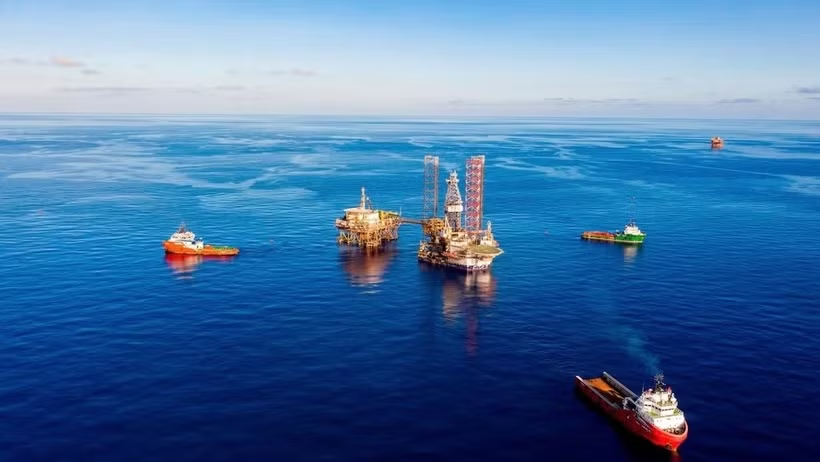
Moving a jack-up rig to an offshore oil and gas drilling site (Photo: Petrovietnam)
Vietnam needs to turn marine data, knowledge and technology into stronger governance capacity, shifting from reactive management to forecasting and from experience-based management to data-driven governance, experts have said.
Prof. Dr. Mai Trong Nhuan from Vietnam National University, Hanoi, said countries with advanced marine capabilities are moving from manual surveys to automated and multi-platform monitoring systems combining remote sensing, monitoring buoys, IoT sensors, autonomous underwater vehicles, remotely operated vehicles and unmanned aerial vehicles with artificial intelligence (AI) and big data.
These technologies enable earlier detection of changes in temperature, water quality, currents and coastlines, while AI can analyse large volumes of data to forecast waves, pollution risks and ecosystem changes. Connecting vessel monitoring data with satellite data can also improve maritime surveillance and help control illegal, unreported and unregulated (IUU) fishing activities, Nhuan said.
Assoc. Prof. Dr. Nguyen Tai Tue from the University of Science under Vietnam National University, Hanoi said more complete, updated and interconnected databases on marine resources and the environment would strengthen management decisions and reduce risks for investors in offshore wind power, marine aquaculture, seaports and other emerging sectors.
Le Anh Thang from the Northern Centre for Planning and Investigation of Marine Resources – Environment said greater use of automation, remote monitoring and unmanned equipment will help reduce offshore hazardous work while increasing the frequency and accuracy of data collection.
Vietnam has established digital databases on marine resources and the environment and is upgrading them for integration with national, ministerial and local databases. The Vietnam Administration of Seas and Islands’ digital transformation plan targets connecting 100% of relevant national and specialised databases by 2030, with at least 80% of monitoring, forecasting and warning activities based on real-time big-data analysis and AI.
The plan places data at the centre, calling for data to be “accurate, sufficient, clean, live, unified and shared”, while developing modern data centres, cloud computing, data lakehouses and IoT networks for automated data collection.
Experts noted that Vietnam still faces shortages of marine research vessels, synchronised data, strong research institutions and high-quality science and technology personnel, while the application of research results remains limited.
They called for closer integration of three areas: marine resource and environmental research, surveys and forecasting; integrated management; and development of a blue marine economy. They stressed that research data should directly support management, planning and monitoring, while practical requirements should generate new tasks for science and technology.
Key priorities include accelerating the use of AI, IoT, satellite data, autonomous vehicles and automated monitoring; developing a national marine data centre; investing in core technologies and high-quality human resources; and creating a market for marine technology products.
Experts also recommended stronger international cooperation in marine research, surveys, forecasting and disaster prevention, along with institutional reform, mobilisation of social resources and greater business participation in developing and applying marine technologies.
VNA