In response to the demands of sustainable development in the new era, many cooperatives in Can Tho City have taken the lead in shifting production models, diversifying products, mechanizing operations, forging partnerships with businesses, and providing input and output support for members. As a result, the shift has not only boosted the value of local products but also raised living standards, contributing to shaping the face of a modern rural landscape.
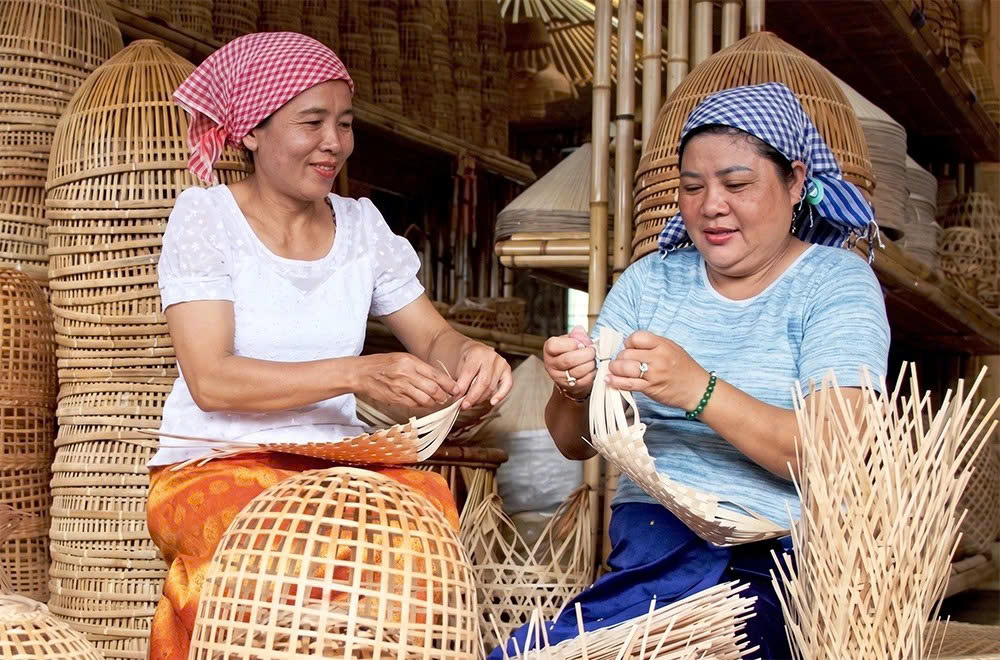
Bamboo and rattan weaving activities at Thuy Tuyet Bamboo and Rattan Weaving Cooperative in Thuan Hoa Commune.
Once plagued by plummeting shallot prices and shaky “rescue” efforts, Vinh Chau Shallot Cooperative in Vinh Chau Ward was founded in 2021 as a stable foothold for local farmers. The cooperative has gradually formalized production procedures, from supplying inputs and training in safe cultivation techniques to supporting market connection.
As a result, farmers can produce with confidence and the value of indigenous agricultural products has increased. Through methodical operations, the cooperative has expanded from 21 founding members to 30 today. It now manages over 16.5 hectares of cultivation area and has offtake agreements covering 90 hectares of shallots for nearly 100 local households.
Building on this success, the cooperative entered a partnership in early 2026 with a company in Ninh Thuan Province to pilot a 5-hectare asparagus farming model involving 6 local households.
According to Mr. Thach Dil, Director of Vinh Chau Shallot Cooperative, the region’s sandy coastal soils, once thought to be barren, have proven to be an ideal environment for growing asparagus with optimal quality: crisp spears, deep sweet taste and vivid green hue.
Crucially, farmers are supported by both the company and the cooperative throughout the entire asparagus production process, from the supply of seedlings and inputs to technical guidance on cultivation and a commitment to buy back 100% of the harvest. Just six months after planting, the asparagus is ready for harvest with stable daily yields averages 10-15kg per hectare.
At a contract price of VND 50,000 per kg, each participating household generates a daily income of VND 500,000 to VND 700,000 (equal to VND 15-21 million per month).
Mr. Thach Dil added that the asparagus cultivation model not only provides farmers with a stable daily income but also offers a climate-resilient production pathway for the region’s sandy coastal land, contributing to prosperous and beautiful rural communities.
Beyond the agriculture sector, many rural cooperatives are also reorienting production to add value to commodities and create more livelihoods for local residents. A case in point is the transformation of Thuy Tuyet Bamboo and Rattan Cooperative in Thuan Hoa Commune, which has affirmed its role as a driver of value chains based on indigenous resources.
Ms. Truong Thi Bach Thuy, Director of Thuy Tuyet Bamboo and Rattan Cooperative, said: “In the past, traditional woven products like baskets and sieves brought low economic value, ranging from VND 20,000 to VND 30,000 per item, making it difficult to sustain the craft village”.
In the face of these challenges, the cooperative made a bold shift in production, transitioning from manufacturing basic household items to high-end eco-furniture and turnkey construction of premium bamboo architectural houses priced from VND 45 million to VND 50 million each.
At the same time, capitalizing on the “green consumption” trend in resorts and hotels, the cooperative scaled up production of environmentally friendly products such as bamboo straws, bamboo cups and handicraft tableware.
With the aim of standardizing product quality and fulfilling large-scale orders exceeding 1,000 units per month for export to discerning markets such as the United States, as well as for domestic distribution, the cooperative brought in machines to mechanize the bamboo splitting and blank-forming stages. This helped shorten the production cycle, reduce manual labor and increase capacity several times over.
Significantly, the cooperative has effectively addressed the issue of social welfare in line with the principle of “leaving farming but not leaving home” by providing stable incomes for 32 members and nearly 70 rural workers, including 75% Khmer, 15% Hoa and 10% Kinh people.
By offering free vocational training classes in handicrafts, the cooperative has turned the dexterity and diligence of local people into a key competitive edge, fostered community cohesion and driven sustainable development in the local economy.
The initiative of Vinh Chau Shallot Cooperative and Thuy Tuyet Bamboo and Rattan Cooperative in flexibly opening new lines of production clearly demonstrates their role as “flagships” leading members to produce in line with market signals. This effort has not only increased the value of agricultural and local specialty products but also contributed to the development of a modern rural landscape.
MY HOA (Translated by MAI QUYEN)








Director: HUYNH HOANG MEN
The license No 789/GP-BTTTT issued by... on Dec 2, 2021
Address: 24 Tran Van Hoai street, Can Tho city - Tel: (0292) 3830098 - Fax: (0292) 3830561 - Email: toasoan@baocantho.com.vn
Contact to Ads: quangcao@baocantho.com.vn
Developed by:


