In recent years, private universities in Can Tho City have made significant investments in faculty, infrastructure, and modern governance. These efforts are driving the development of a high-caliber workforce for the city and the entire Mekong Delta region.
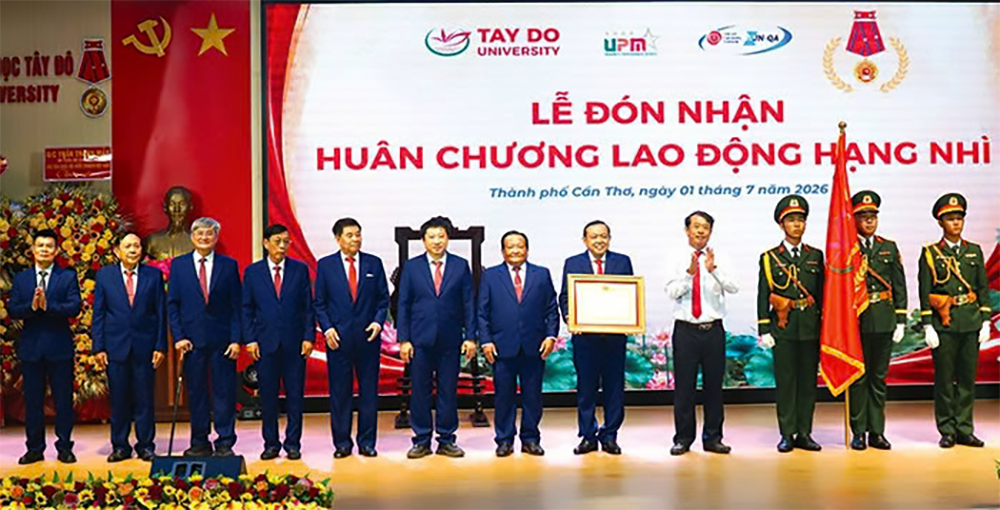
Mr. Nguyen Van Khoi, Vice Chairman of the People's Committee of Can Tho City, on behalf of the State, presented the Second-Class Labor Medal to Tay Do University.
Achievements from investing in education
Tay Do University, the first private university in the Mekong Delta, was honored to receive the Second-Class Labor Medal in early July 2026. The award not only marks a new stage of development but also affirms the effectiveness of the Party and State’s policy on the socialization of education.
After 20 years, Tay Do University has trained more than 32,400 bachelor’s degree holders, engineers, pharmacists, and more than 1,300 postgraduate students. The graduate employment rate exceeds 85%. More than 80% of lecturers hold postgraduate degrees; 16 training programs accredited nationally and 4 programs assessed under AUN-QA standards. The university has carried out 248 scientific research projects and published more than 1,600 articles in domestic and international journals.
According to Meritorious Physician, Prof. Dr. Tran Cong Luan, President of Tay Do University, receiving the medal inspires and commits the university to continuously raising its education standards. The university is committed to advancing scientific research, innovation, and digital transformation, while pursuing national and international quality accreditation and expanding cooperation with enterprises and educational institutions to raise the university’s standing.
After more than 13 years of operation, Nam Can Tho University, or DNC, offers 46 undergraduate and 14 graduate programs, serving more than 23,000 students and over 150 international students. In 2026, the university was placed in the 801-1,000 band of the THE Impact Rankings worldwide. DNC had previously earned 4 QS Stars and 5 UPM stars. These results reflect its long-term investment in facilities, personnel and the enhancement of education quality. DNC currently has 5 professors, 24 associate professors, 291 Ph.D. holders and 502 master’s degree holders.
Building an education & innovation ecosystem
For 2026-2030, Tay Do University aims to focus on the core values of “Solidarity - Cooperation - Wisdom - Innovation”. This will be achieved through modern governance, digital transformation, upgraded digital infrastructure, stronger faculty and international integration.
The university aims to build strong research teams aligned with regional demand, targeting at least 200 papers annually in ISI/Scopus-indexed journals. Additionally, it seeks to expand global partnerships, industry partnerships, English-taught programs and student exchanges to enter world university rankings.
Meanwhile, DNC is developing an education - healthcare - enterprise ecosystem centered on innovation. The university will launch a DNC Digital Technology and Innovation company focused on digital transformation, research, technology adoption and innovation across its ecosystem.
DNC officials asked the Can Tho City People's Committee to support its development toward becoming a modern, multidisciplinary and globally integrated institution. It also requested allocating a 108-hectare land fund next to its current campus for the proposed “DNC International University Urban Area”. This project aims to create an ecosystem of education, research, healthcare, innovation, serving as a modern urban hub for Can Tho and the broader Mekong Delta.
Mr. Truong Canh Tuyen, Chairman of the Can Tho City People's Committee, said the city is building a development strategy around its competitive strengths, with education and training serving as a key pillar for its role as the Mekong Delta's hub. Alongside public universities, private institutions play a vital role in nurturing high-quality talent. Can Tho is working on policies for healthcare, science, technology, innovation, culture, sports and tourism. These priority areas will be integrated into planning, projects and special development mechanisms to effectively mobilize investment capital. The city calls on universities, research institutes and enterprises to join the local innovation ecosystem.
The city's leaders reaffirmed their commitment to supporting educational institutions to help provide high-quality talents for Can Tho and the region.
B.KIEN (Translated by MAI QUYEN)








Director: HUYNH HOANG MEN
The license No 789/GP-BTTTT issued by... on Dec 2, 2021
Address: 24 Tran Van Hoai street, Can Tho city - Tel: (0292) 3830098 - Fax: (0292) 3830561 - Email: toasoan@baocantho.com.vn
Contact to Ads: quangcao@baocantho.com.vn
Developed by:


