In Vinh Chau Ward, Can Tho City, shallot fields deeply rooted in the Khmer community are steadily transforming. Farmers are taking the initiative to improve quality, strengthen value chains, build brands, and ensure stable market access, establishing a strong foundation for rural economic development.
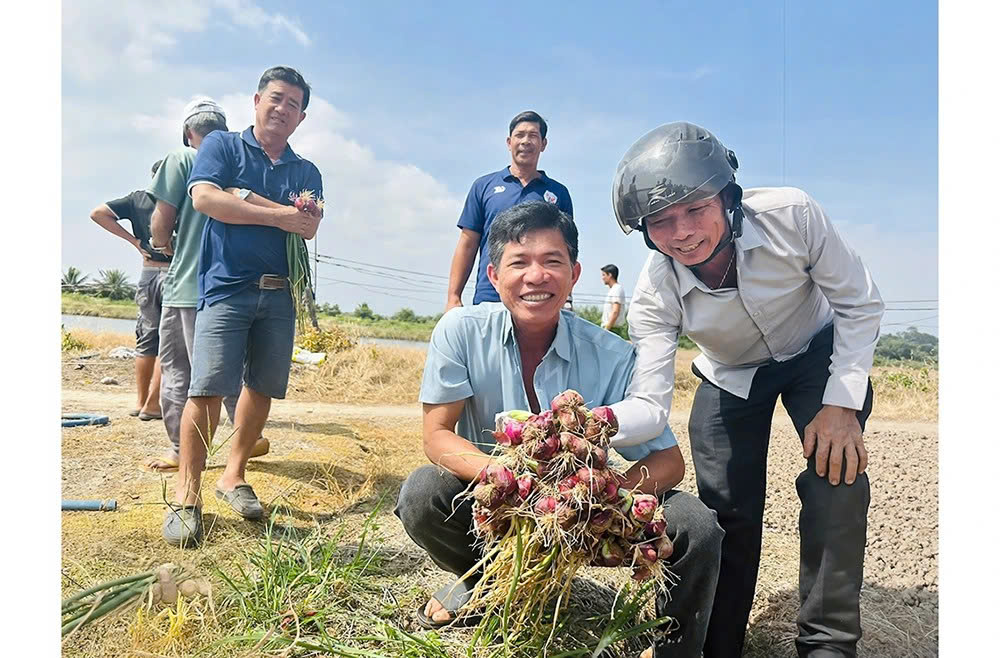
Vinh Chau shallot farmers focus not only on better quality but also on value chain integration and brand development.
Changing the way they farm
In Vinh Chau, where over half the population is Khmer, shallot is not only the hallmark crop but also the primary livelihood for thousands of households. Well-suited to local soils, with a short-growing period and relatively long storage life, it has become the area's main agricultural product.
Vinh Chau shallot has been trademarked since 2009, granted geographical indication status in 2019 and certified as a 3-star OCOP product. These advantages enable the locality to develop higher-quality, higher-value products. However, shallot production continues to face challenges related to weather, rising input costs and volatile prices. Added to that, fragmented production, insufficient storage, and reliance on middlemen limit farmers' ability to time their sales proactively.
This situation demands innovation not only in cultivation techniques but also in production organization. Rather than farming independently and finding their own markets, farmers should enhance cooperation, align production processes, raise quality and actively connect with businesses. Cooperatives are progressively taking on a connecting role, helping farmers move from fragmented production to market-driven linkages.
At Hoa Thanh Vegetable Cooperative, Nen Bieu hamlet, Vinh Chau Ward, 14 members are cultivating 14ha, including 3ha of shallots grown under organic-oriented practices. Most of the workers in the model are Khmer. Mr. Thach Tien, Director of the Cooperative, said that organic and bio-based farming helps cut input costs. Joining linkages also makes it easier to sell products, contributing to more stable prices. Products are kept in cold storage and are purchased under contract by enterprises.
In 2026, Vinh Chau farmers planted nearly 6,500ha of shallots, including over 5,000 ha for commercial production and the remaining area allocated for seed production. The area under organic-oriented farming covered 1,148.4ha. Certain areas were planted with the Dutch Maserati F1 variety, yielding approximately 18-20 tons per ha.
Expanding markets to boost agricultural value
Alongside changes in cultivation methods, cooperatives in Vinh Chau are stepping up consumption linkages, connecting with businesses, wholesale markets and retail chains.
Vinh Chau Shallot Cooperative now has 30 official members and 200 affiliated production members. Besides 16.5ha of directly cultivated land, the cooperative has partnerships covering more than 90ha of rice, seed shallots, commercial shallots, off-season shallots, chilies and asparagus. In 2025, the cooperative planted 1.5ha of seed shallots, with a yield of 10 tons/ha and an output of 15 tons for stockpiling. For Dutch shallots, it has affiliated production across multiple localities in Can Tho City and nearby provinces. In 2026, the cooperative expects to plant 5ha of seed shallots, 10ha of early-crop shallots, 30-40ha of main-season shallots and 50ha of Dutch shallots.
According to Mr. Thach DIL, Director of Vinh Chau Shallot Cooperative, the entity is working with import-export firms in Ho Chi Minh City, selling an average of 5-7 tons of shallots a month. The cooperative is also pushing trade promotion, linking with wholesale markets, businesses, and supermarket chains, with a focus on product traceability, VietGAP standards and OCOP product upgrades.
However, market expansion needs to be matched with better storage and sales organization. For seasonal crops like shallots, a lack of storage and stable sales contracts can leave farmers in a vulnerable position. The cooperative is therefore requesting support to build a cold storage warehouse, accessing preferential capital, renewing its 3-star OCOP certification and completing paperwork to upgrade to 4-star OCOP.
During the first 9 months of 2026, the planted and harvested area of shallots in Vinh Chau reached 3,500 hectares, meeting 100% of the target, with an output of 59,462 tons, or 101.09% of the target. According to Ms. Nguyen Thi Hoa Binh, Chairwoman of the Vinh Chau Ward People's Committee, the locality will continue to stepping up communication and trade promotion for OCOP products, working with the Department of Industry and Trade and relevant agencies to facilitate agricultural production and distribution.
Six organizations and individuals are licensed to use the Vinh Chau shallot geographical indication. The Can Tho Department of Industry and Trade also supports cooperatives and enterprises in joining trade fairs, business matching events, and supply-demand connection activities, helping products access supermarkets, retail chains, wholesale markets, OCOP outlets, rest stations, and e-commerce platforms.
Experience in Vinh Chau shows that shifting production structures, developing the cooperative economy, and boosting linkages in production and consumption are opening up positive opportunities for residents, including Khmer compatriots. Cooperative models not only link households together but also help reduce risks, raise production efficiency, and add value to farm produce. However, for this direction to be effective in the long term, it is necessary to further improve value chains, invest in storage infrastructure and build stable markets, thereby enhancing agricultural value and laying the firm foundation for sustainable development in Khmer rural areas.
KHANH NAM (Translated by MAI QUYEN)









Director: HUYNH HOANG MEN
The license No 789/GP-BTTTT issued by... on Dec 2, 2021
Address: 24 Tran Van Hoai street, Can Tho city - Tel: (0292) 3830098 - Fax: (0292) 3830561 - Email: toasoan@baocantho.com.vn
Contact to Ads: quangcao@baocantho.com.vn
Developed by:


