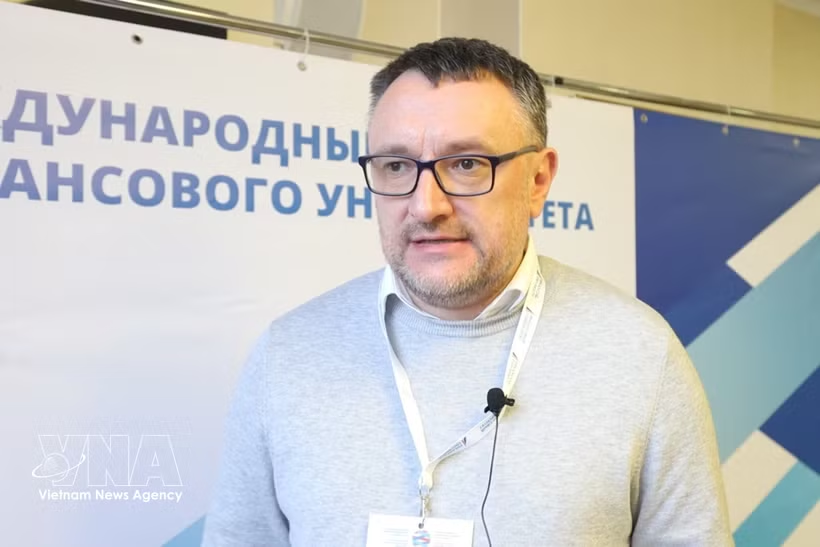
 Assoc. Prof. Maxim Kazanin from the International Business Department, Faculty of International Economic Relations of the Financial University under the Government of the Russian Federation (Photo: VNA)
The theme “Jointly Forging a New Era of Resilience, Innovation and Prosperity,” proposed by Vietnam for APEC Year 2027, sends an important and timely political and economic message to member economies of the Asia-Pacific Economic Cooperation (APEC) forum and the wider world, a Russian expert has said.
In an interview with Vietnam News Agency (VNA) correspondents in Moscow, Assoc. Prof. Maxim Kazanin from the International Business Department, Faculty of International Economic Relations of the Financial University under the Government of the Russian Federation, said the theme, put forward by General Secretary of the Communist Party of Vietnam Central Committee and President To Lam, directly addresses current global challenges.
He noted that global uncertainty is increasing risks and threats to the stability of the world economy and global supply chains, while negatively affecting national economic interests. The theme, therefore reflects the demands and challenges of the current era and guides the shaping of economic relations, trade agreements, and industrial systems.
Kazanin stressed that the theme should also serve as a common goal in developing multilateral and bilateral relations, including between Russia and Vietnam, Vietnam and fellow ASEAN members, and other countries. He described it as a thoughtful message for all stakeholders, particularly APEC member economies.
Assessing Vietnam's role as host of APEC Year 2027, he praised the country's proactive consultations in proposing the theme and priorities, saying that giving top priority to improving economic productivity is particularly appropriate to current trends.
According to the expert, emerging technologies and artificial intelligence (AI) represent the next stage of comprehensive production automation. AI algorithms, combined with sophisticated components, powerful microprocessors, and high-speed computing capabilities, could simplify production processes and create more efficient production networks, thereby improving economic productivity.
Kazanin said Vietnam's manufacturing sector can benefit from these developments through both the acquisition of advanced technologies and the development of its own designs.
He noted that thousands of talented young Vietnamese specialists are studying and conducting research in industry, economics, electronics and computing systems in Russia and other advanced countries, he noted, expressing the hope that they will return home and help drive breakthroughs, including in Vietnam's digital economy.
Regarding Vietnam's position in APEC, Kazanin affirmed that Vietnam is one of the key members in the economic field. Vietnamese businesses, he said, are actively integrating into the global economy and making important contributions to the operations of major international brands and companies.
According to the expert, Vietnam also boasts distinct advantages through access to local resources and its role as an international connectivity hub. Its location in the East Sea makes it not only an important partner but also a key factor in the stable development of regional and international cooperation frameworks.
Kazanin predicted that Vietnam could gain significant development momentum from international economic frameworks over the next five to 10 years, particularly in manufacturing, digital economic development, new materials and emerging technologies. He added that considerable potential remains untapped in the country's modern trade and economic relations.
VNA