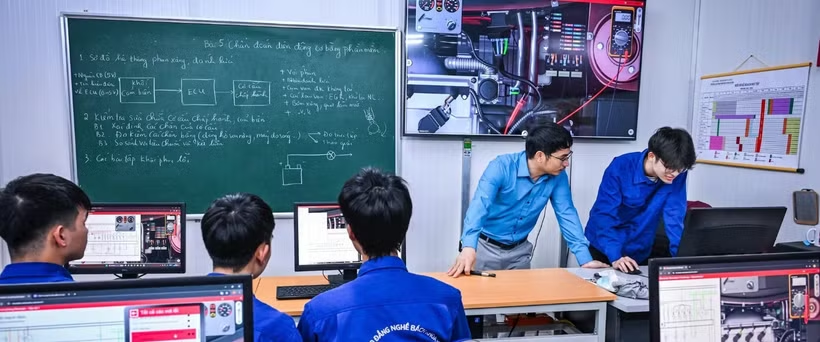
 Hands-on training will create a sustainable talent pool for labour market restructuring (Photo: nhandan.vn)
Vietnam’s labour market is hurtling toward a massive shake-up as artificial intelligence (AI) sweeps through every industry, fueled by an aging population and the fading power of cheap labour, igniting urgent need for reforms that can help workers pivot and prosper in the new economy.
AI’s sweeping toll on employment
Adoption is moving faster than anyone predicted, turning AI into one of the most powerful forces reshaping labour markets worldwide, and Vietnam is squarely in its path. As AI technologies keep advancing, especially when woven together with automation systems and robotics, workers across a vast range of industries and occupations face mounting risks of being displaced.
A mid-2025 report from Microsoft Vietnam found that the country is home to about one million information technology (IT) engineers, and as many as half of them may need to switch to entirely new roles because of AI. The report also revealed that 91% of corporate leaders are already considering hiring specifically for AI-focused positions.
Nguyen Van Khoa, Chairman of the Vietnam Software and IT Services Association (VINASA), pointed out that some companies have slashed their workforce by as much as 70% after bringing in AI technologies.
Moreover, the breakneck advance of Generative AI (GenAI) is expected to land an even heavier blow on workers. A recent report titled “GenAI and jobs in Vietnam: Labour market exposure and policy considerations”, published by the International Labour Organisation (ILO) office in Vietnam, found that around 20.8% of all jobs, or roughly 11.5 million workers, could be affected. Instead of wiping out entire occupations, GenAI is set to dramatically reshape how tasks are done inside jobs, meaning a huge number of positions will need to be redesigned.
The trend is coming into sharp focus: as technology marches forward, traditional labour opportunities shrink. This shift threatens to create a class of “hidden unemployed” workers who remain on a payroll but earn far too little and see few chances to move up. Against this grim backdrop, Dr. Pham Xuan Khanh, Principal of the Hanoi High Technology College, issued a stark warning that Vietnam simply doesn’t have enough highly skilled professionals in emerging fields, while workers’ ability to jump between occupations is severely limited. Employees can no longer afford to sit still.
At a deeper level, AI is exposing a painful truth that Vietnam’s labour market can’t keep up with the rocketing demand for quality digital talent.
Adapt or get left behind?
Even though Vietnam produces a substantial number of IT graduates every year, a huge share still can’t meet what enterprises actually need, particularly in fast-emerging areas like AI, big data, and cybersecurity. The gap between education and market demand can never be fully closed, but shrinking it is essential to keeping future growth alive.
Dr. Vu Xuan Hung, a labour and employment expert, suggested Vietnam move aggressively to strengthen governance and AI competency frameworks for workers, push responsible AI use, reinforce labour market information systems, and pour investment into skills development, with a heavy focus on digital and soft skills.
At the same time, policies must put far more weight on gender equality to guarantee that women aren’t left behind as the technological wave rolls through, he insisted.
Tran Anh Tuan, Vice Chairman of the Ho Chi Minh City Vocational Education Association, stressed the urgent need for tighter state management of workforce development, far better coordination among career guidance, recruitment, and training activities, and a much closer match between practical training and what the labour market actually demands.
He made the case for rolling out incentives that push firms to invest in technology and vocational training, building stronger links between schools and real production floors, and establishing innovation hubs inside schools and hands-on training facilities within enterprises.
Vietnam, he went on, must design comprehensive support strategies for workers displaced by technological change, including reskilling and upskilling courses that keep human beings firmly at the centre of the workforce.
That kind of foundation, he added, will allow AI to become an engine of higher productivity, boost investor confidence, and sharpen Vietnam’s national competitiveness for years to come.
VNA