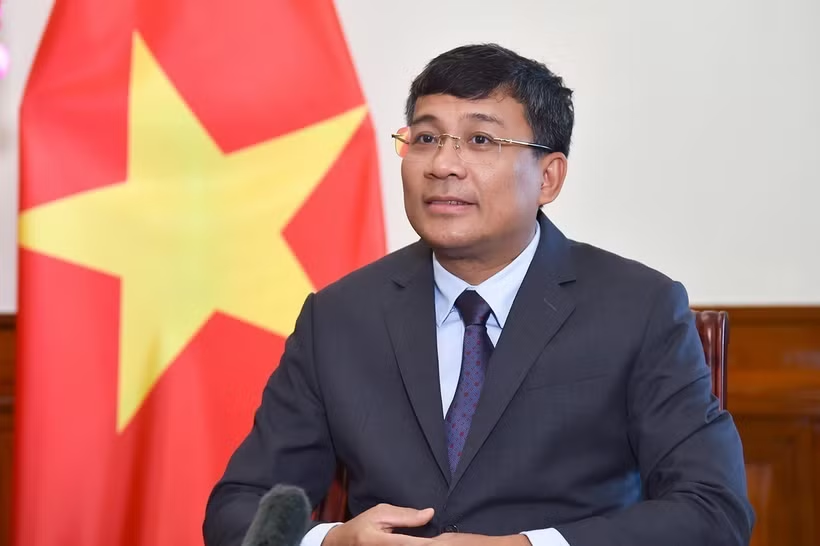
 Permanent Deputy Minister of Foreign Affairs Nguyen Minh Vu (Photo published by VNA)
The 33rd APEC Economic Leaders’ Week in China’s Shenzhen is set to inject new momentum into trade, investment, connectivity and innovation, and give Vietnam and other member economies a platform to make APEC 2027 a success, Permanent Deputy Minister of Foreign Affairs Nguyen Minh Vu told the press.
Vu described the November 17–20 trip by General Secretary of the Communist Party of Vietnam Central Committee and President To Lam and his spouse to attend the week in Shenzhen and conduct bilateral activities in China as a key diplomatic and economic push.
He said APEC’s 21 economies account for over 60% of global GDP and nearly 50% of global trade, and include many of Vietnam’s most important economic partners. Amid a pivotal transition for the world and the region and rising macro uncertainty, the trip reaffirms APEC’s core agenda, including open economies, trade and investment facilitation, economic and technical cooperation. Shenzhen, known as China’s reform and opening-up showcase, together with APEC 2026’s priorities of openness, innovation and cooperation send a message that without cooperation and innovation, there are no growth success stories and no regional dynamism.
Vietnam arrives as APEC 2027 host. In Shenzhen, the top Vietnamese leader will formally take over the host role. Vietnam will use the week to sound out members and build support for an agenda that is both practical for the region and long-term in scope, reinforcing its role and responsibility in APEC.
According to Vu, the trip is also a bilateral push, especially Vietnam - China relations. Meetings with leaders of major economies are aimed at deepening ties and opening trade, investment, sci-tech and innovation opportunities. With China, Vietnam wants high-level understandings to turn into concrete projects in infrastructure connectivity, logistics, high technology and business linkages. activities in Shenzhen open opportunities to tighten connectivity with the Guangdong–Hong Kong–Macao Greater Bay Area, leverage technology, manufacturing, finance and services strengths to widen cooperation and create new growth momentum. Yunnan activities will target economic links between southwestern China and Vietnam, especially border provinces.
After a year of APEC 2026 work, the Shenzhen leaders’ meeting is billed as the capstone and a new spark for regional integration. Vietnam wants it to reinforce confidence in open trade, investment and mutual gains. With trade barriers rising and supply chains being redrawn, APEC must deliver on trade facilitation, supply chain links, lower logistics costs and support for small and medium-sized enterprises, including digital and AI uptake, he said.
He added that Vietnam wants Shenzhen outcomes to set up its 2027 host year: build on APEC 2026, push strategic cooperation that fits new regional development needs, and produce concrete, durable results.
Vietnam expects the results and consensus reached in Shenzhen to create a solid foundation and favourable momentum for APEC Year 2027 in Vietnam, he said, adding that Vietnam wishes to build on the outcomes of APEC 2026 and, together with members, advance strategic cooperation orientations that meet the region’s new development requirements while producing concrete, practical and long-lasting results.
The high-level meetings and business matchmaking in Shenzhen should convert commitments into projects in trade, investment, technology and innovation, pulling Vietnamese firms deeper into global and regional chains.
In Shenzhen, Vietnam and China will link growth poles and tap Greater Bay Area strengths, especially in high technology, advanced manufacturing, supporting industries, while pairing quality investment with workforce training. In Yunnan, they will push transport connectivity, modern logistics, an early smart border-gate model, border exchanges and effective border management, he added.
VNA